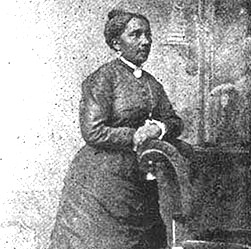
Elizabeth Jennings

Elizabeth Jennings Graham, 1830-1901, won early civil rights court case to ride streetcar in NYC in 1854. New York’s version of a ‘Rosa Parks’ figure.

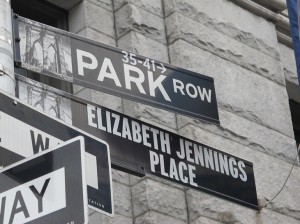
Elizabeth Jennings was a sister with an attitude. About 100 years before Rosa Parks, Elizabeth Jennings refused to get off a horse-drawn streetcar in New York when ordered to. Think of Miss Jennings as a ‘Rosa Parks’ with a New York attitude.  Not only did the 24 year-old teacher and church organist refuse to get off the horse-drawn streetcar, but she fought the driver, conductor and policeman, reminded them of her rights, sued them and the transit company and won! Oh, and did I mention that her lawyer went on to become president of the United States? More on that later. Thanks to some conscientious New York City school children, a street was named Elizabeth Jennings Place in Lower Manhattan in 2007 at Park Row and Spruce Street. More on the school children later.

I first heard about Miss Jennings (later she married Charles Graham) from Rev. Dr. Calvin Butts who preached about her from the pulpit at Harlem’s Abyssinian Baptist Church years ago in honor of Black History Month. Elizabeth Jennings is one of my favorite unsung sheroes. She was courageous and outrageous, two important qualities needed in the long struggle for women’s equal rights in this nation.

Miss Jennings was wealthy and educated during a time when most African Americans were not. In fact, most were enslaved. Can you imagine being a BAP-Black American Princess during slavery?  Her father was a successful, well-connected tailor with a shop on Church Street. He held patents on methods for renovating clothing and was an abolition leader at two major Black churches— Abyssinian and St. Phillips, both located in Lower Manhattan, New York’s original Black community!  Usually, Miss Jennings was transported around town by her chauffeur. But on this day she and her friend Sarah E. Adams were running late for choir practice at the First Colored Congregational Church on Sixth Street and Second Avenue. She flagged the streetcar that picked her and her companion up at Pearl and Chatham streets on Sunday, July 16, 1854. Then, things went downhill. The conductor and driver tried to kick her off.
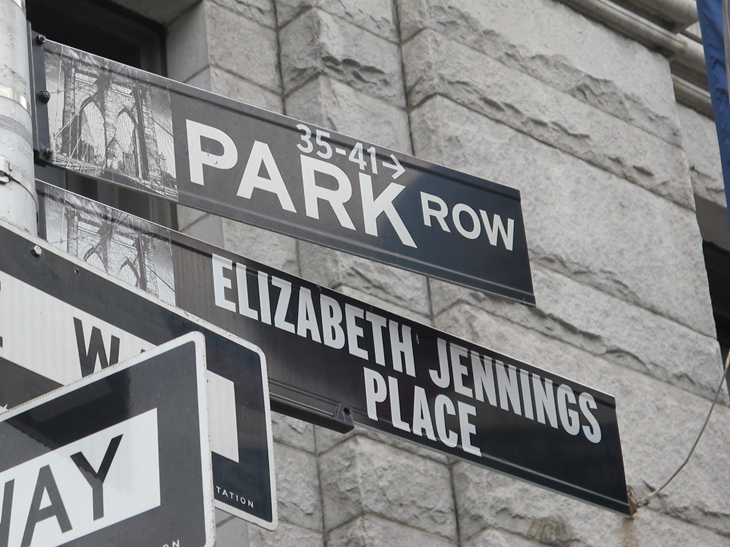
NYC street named Elizabeth Jennings Place, an African American schoolteacher who refused to get off the streetcar in 1854.

The Details— Here’s an account that was read aloud (as she was still recovering from injuries, her words were read by the meeting secretary) from an open letter to the church rally and as published in Horace Greeley’s New York Tribune, July 19, 1854, 7:2 (edited) article: Outrage Upon Colored Persons “I held my gloved hand up to the driver and he stopped the cars. We got on the platform, when the conductor told us to wait for the next car. I told him I could not wait, as I was in a hurry to go to church.  He insisted upon my getting off, but I did not get off. He waited a few minutes, when the driver, becoming impatient, said to me, “Well, you may go in, but remember, if the passengers raise any objections you shall go out, whether or no, or I’ll put you out.”

 I then told him that I was a respectable person, born and raised in New York, that I had never been insulted before while going to church, and that I did not know where he came from but that he was a no good for nothing impudent fellow for insulting decent persons while on their way to church. He then said that he would put me out.

 I told him not to lay his hands on me. He took hold of me and I took hold of the window sash and held on; he pulled me until he broke my grasp and I took hold of his coat and held onto that but previously he had dragged my companion out, she was all the while screaming for him to let go of me. A crowd gathered. The driver then went to his horses. I went again into the car. The conductor said, “You shall sweat for this.”

 He then told the driver to drive as fast as he could and not to take another passenger in the car, to drive until he saw an officer or a Station House. We saw an officer at the corner of Walker and Bowery and he without listening to anything that I had to say, thrust me out, and then pushed me down, and tauntingly told me to get redress if I could. I would have come up myself, but am quite sore and stiff from the treatment that I received from those monsters in human form yesterday afternoon.” (this account was picked up by Black and White newspapers across the nation!)

New York, being the financial capital of slavery during the time,  was full of organized movements among successful, free, Black New Yorkers to end discrimination and slavery. These activities were led by her father, Thomas Jennings and his notable white and black friends and colleagues. Frederick Douglass, her father’s dear friend, publicized Miss Jennings’ story and it became a national sensation. A huge community rally was held and a Black Legal Rights Association, a precursor to the NAACP, was formed at the First Colored Congregational Church. She decided to sue.

Jennings Wins in Court—Jennings did win her landmark case Jennings V. Third Avenue Rail. Frederick Douglass’ paper, March 2, 1855, 2:5 “Legal Rights Vindicated,” stated: “Our readers will rejoice with us in the righteous verdict. Miss Elizabeth Jennings, whose courageous conduct in the premises is beyond all praise, comes of a good old New York stock. Her grandfather, Jacob Cartwright, a native African, was a soldier in the Revolutionary War, and took part in city politics until his death in 1824; her father Mr. Thomas L. Jennings, mentioned in our paper many times, is founder and leader of institutions for the benefit and elevation of the colored people…”

The case was also reported in a New York Tribune, February 23, 1855, 7:4. article “A Wholesome Verdict.” Judge Rockwell of Brooklyn Circuit Court instructed the jury that the transit company was “liable for the acts of their agents, whether committed carelessly and negligently, or willfully and maliciously. That they were common carriers, and as such bound to carry all respectable persons including colored persons.”

Furthermore, the judge said:  “Colored persons if sober, well behaved and free from disease, had the same rights as others and could neither be excluded by any rules of the Company, nor by force or violence.”

Miss Jennings sued for $500 and the majority of the jury wanted to give her the full amount. But as the Tribune stated: “Some jury members had peculiar notions as to colored people’s rights.” (BTW, the transit driver, conductor and police were all Irish immigrants, it was stated in the court proceedings.)

Miss Jennings’ lawyer—A settlement of $225, with the court adding 10 percent, plus her legal expenses was the final agreement. Within a month of this case, an African American man sued and won a similar public transit case and settled out of court. Miss Jennings’ lawyer Chester A. Arthur, later became a Civil War officer and politician. He was elected US Vice President in 1880 and became US President when President James Garfield was murdered in 1881.

Civil War Draft Riots—Some years later after the Jennings’ case, in July 1863, a resolution allowed wealthy New Yorkers to buy their way out of the Civil War draft. An angry white mob, mostly Irish immigrants who competed for slave work and blamed the Black people for the Civil War, rioted over a four-day period. More than 70 African Americans, mostly, successful, free men, women and children were killed and over 20 were lynched. Elizabeth Jennings Graham’s young son died during that time.

NYC Pupils Saved Elizabeth Jennings from Obscurity—In the end I say, God bless the New York City public school children, their teachers and parents who saved Miss Elizabeth Jennings from obscurity.

‘”After finding out about Elizabeth Jennings in preparation for a show on Martin Luther King Jr., a group of third and fourth graders from P.S. 361 on the Lower East Side took the initiative in 2007 to get her name immortalized at the corner of Spruce Street and Park Row. After a year of attending meetings, gathering petition signatures, and pressuring elected officials, they were able to get a street sign named for her—a feat that had been unsuccessful by another group of students in 1990s,” stated a blog posted on womensenews.org called “The Story Behind Elizabeth Jennings Place.”

“In 1991, four sixth grade girls in the Museum of the City of New York’s Wednesday afternoon history club researched the life of Elizabeth Jennings, whom they called the Rosa Parks of her time, and presented a play, ”Elizabeth Jennings Fights for Her Rights,” at the museum’s first history fair. At the fair they collected signatures on a petition asking for the City Council to name one of the corners of Park Row (originally Chatham Street) and Pearl Street in honor of Elizabeth Jennings and forwarded the petitions to the City Council. Unfortunately, the Council never responded, according to a “Letter to the Editor” by Kathleen Benson, head of Education, Museum of the City of New york, September 17, 1994,” it was reported in NY Times article “A Civil Rights Victory in Old New York.”
Digital Award

AVA Digital Awards Announce 2013 Winners

Narrative Network wins AVA Digital Gold Award from among 2000 global entrants

My Hakka Chinese family from Caribbean pose in Los Angeles on way back to Harlem.

New York, NY (February 1, 2013) Narrative Network and LS3 Studios are winners of the AVA Digital-Gold Awards, for co-producing documentary trailer “From Shanghai to Harlem,” in the category of Creativity Video Production/Editing, it was announced on February 1, 2013. AVA recognizes outstanding achievement by creative professionals involved in the concept, direction, design and production of media that is part of the evolution of digital communication. Work ranges from audio and video productions to websites and social media sites that present interactive components such as video, animation, blogs, and podcasts to other user-generated digital communication.

There were 2,000 entries from throughout the United States, Canada and several other countries in the 2013 competition. Entrants included digital professionals from audio, video and film production companies; web developers; advertising agencies; PR firms; corporate and government communication departments; and independent creative professionals such as designers, producers, directors, editors and shooters.

AVA Digital Awards is sponsored and judged by the Association of Marketing and Communication Professionals (AMCP). The international organization consists of several thousand production, marketing, communication, advertising, public relations, and free-lance professionals. AMCP administers recognition programs; provides judges and rewards outstanding achievement and service to the profession. As part of its mission, AMCP fosters and supports the efforts of creative professionals who contribute their unique talents to public service and charitable organizations.

Judges are industry professionals who look for companies and individuals whose talent exceeds a high standard of excellence and whose work serves as a benchmark for the industry.

Winners, who will receive certificates and inscribed statuettes, were selected from over 200 categories in Audio, Video, and Web-based production. A list of Platinum and Gold Winners can be found on the AVA Digital Awards website at www.avaawards.com

Chinese New Year’s Greetings!

In honor of my Chinese ancestors, Gong Xi Fai Cai!, from my family to yours. Wishing you a prosperous Year of the Water Snake!

My Chinese ancestors come from Trinidad and Guyana. Many people ask me: “How did the Chinese land in the West Indies?” The short answer is: Slavery. But the full answer is more complicated than that. The Chinese in the Caribbean had to do with indentured workers, migration and immigration. Then their story gets more complicated!

Here is an excerpt from Indentured Labor, Caribbean Sugar-Chinese and Indian Migrants to the British West Indies, 1838-1918, by Walton Look Lai, page 87-88.

“Life and Labor on the Plantations: The Chinese”: When the Cantonese region began to show increased emigration activity in the years following the first so-called Opium Wars (1839-42), Western importers began to pay active attention to the prospect of recruiting cheap labor from this source. A British parliamentary committee had tried to revive the issue of Chinese immigration to the West Indies as early as 1811, but there was no follow-up. In 1843, licenses for the importation of 2,850 Chinese were actually granted (six for British Guiana and 2,150 immigrants, one for Trinidad for 300, and one for Jamaica for 400). But the projects were never undertaken because at this point the importers were expected to bear the financial risks themselves, and their agents in the East could not get many Chinese to migrate to the West Indies voluntary.”

But eventually, many Chinese indentured workers did arrive in the Caribbean islands to replace the formerly enslaved Africans and native Caribbeans. According to many oral history documents recently translated, many of those early Chinese migrant workers were given false papers, some were forced onto ships and treated as bad or worst than the African slaves. My family stories are still being discovered through genealogy and research. The search continues. Stay tuned!

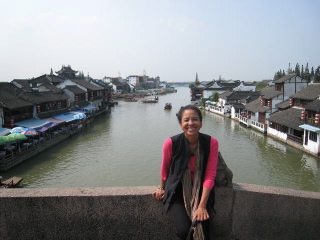
Sylvia Wong Smith Lewis in canal village in Shanghai, China.


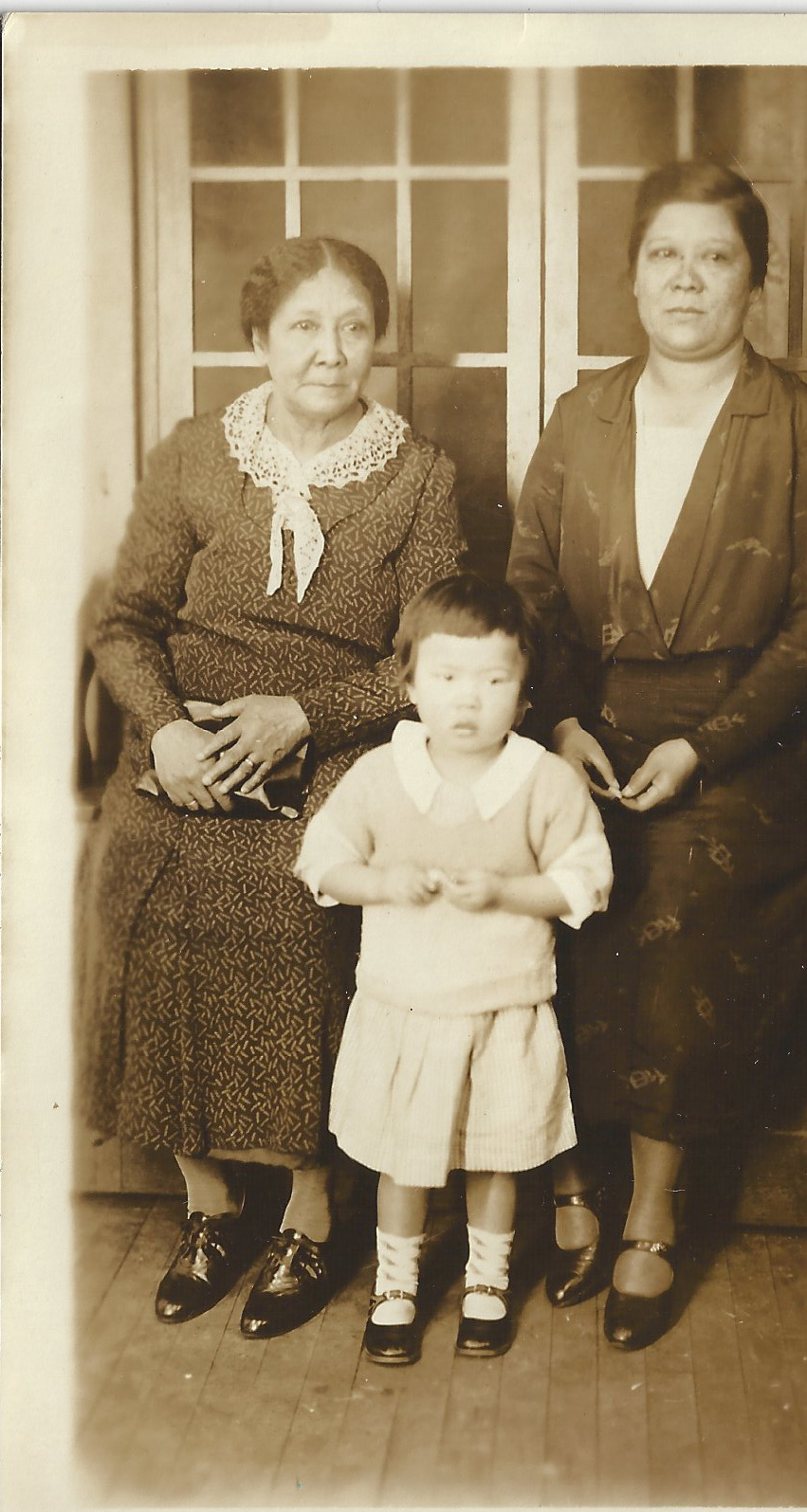
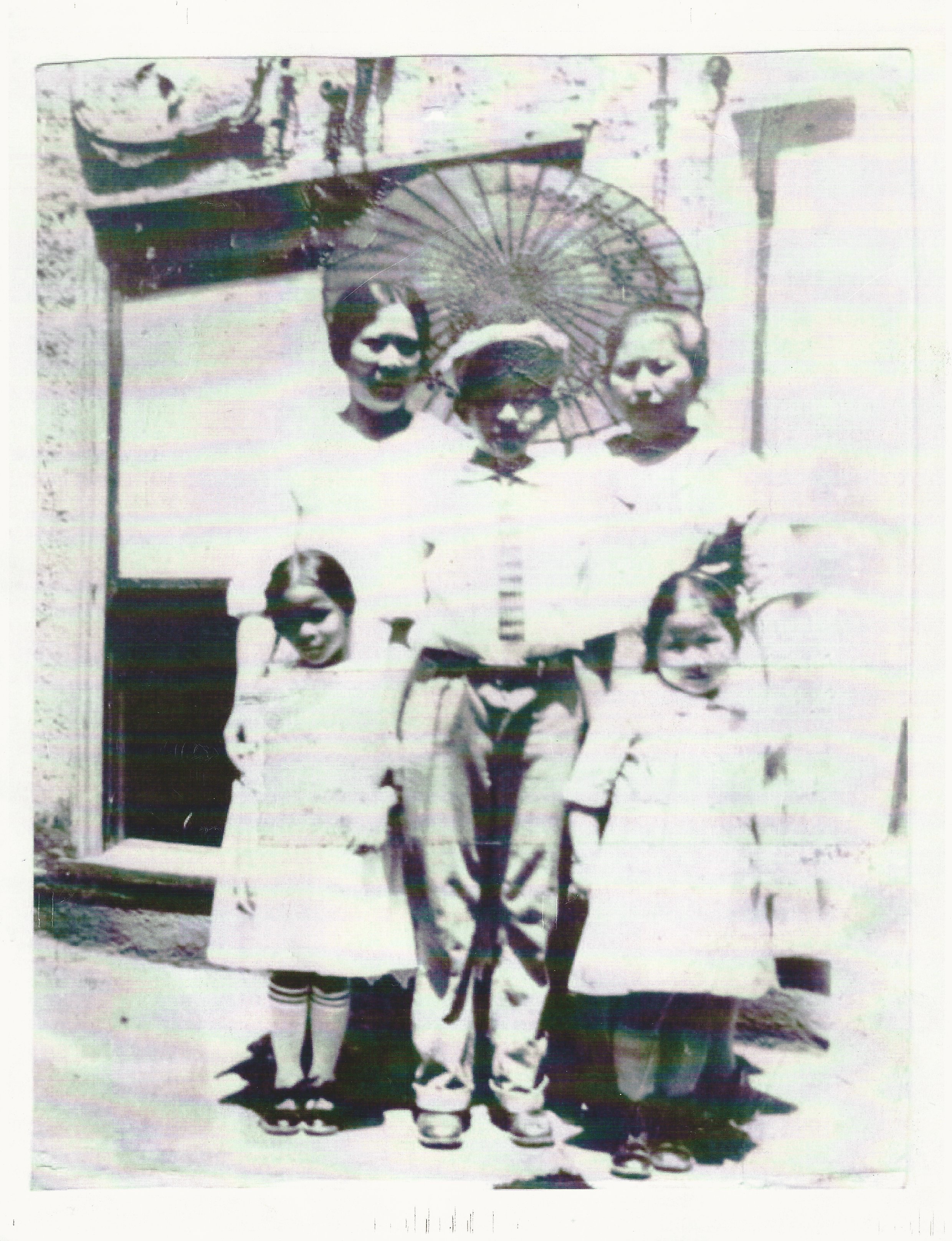
Paulina Joy (maternal great grandmother); Emily Looney, maternal grand aunt (grandmother Violet’s sister); Pauline Chan Keong (my mother’s baby sister). Photo taken in China on way back to Los Angeles.


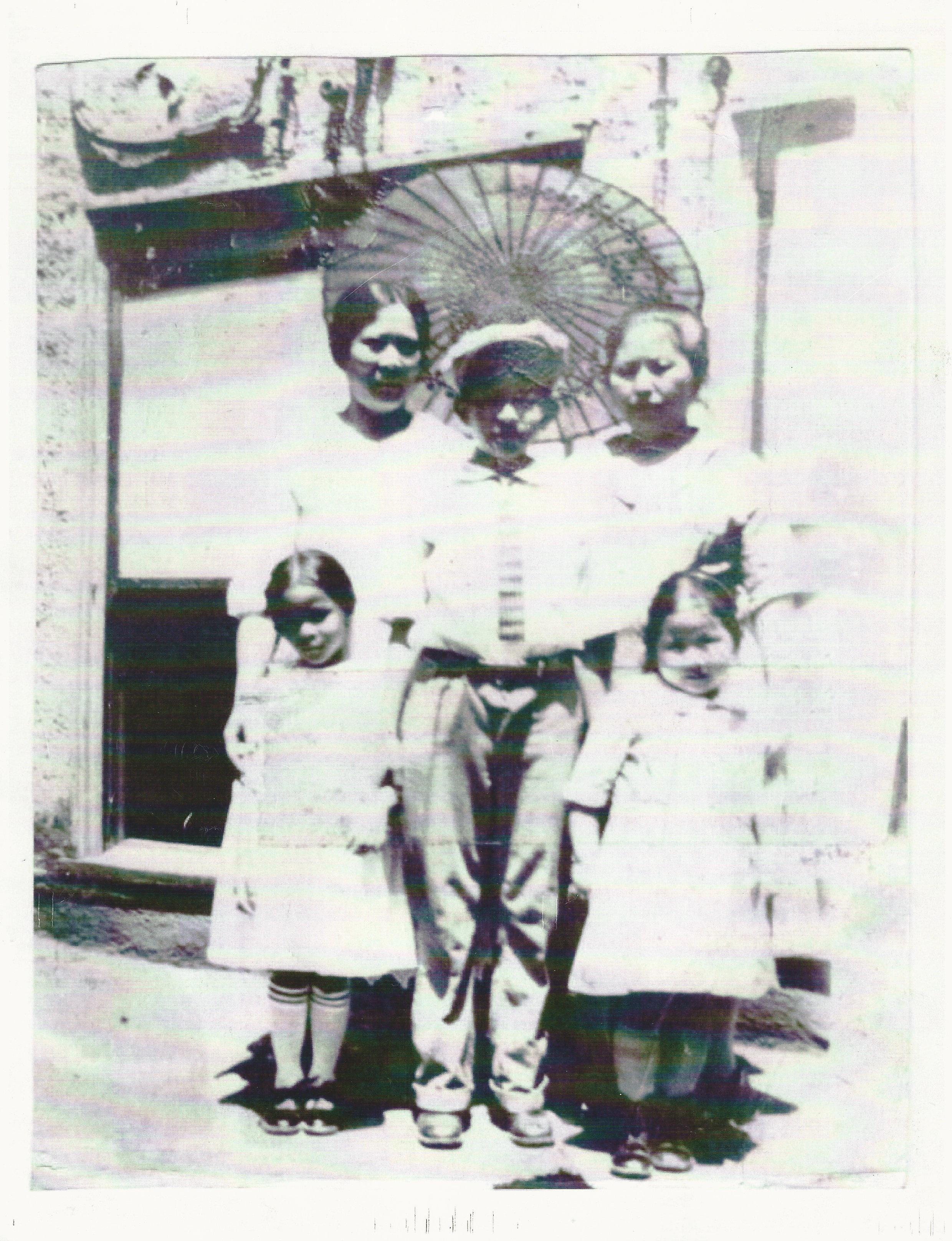
My mother Carmen, grandmother Violet, Uncle Owen, grand Aunt Emily, Sakaye, Japanese ‘cousin’ who was adopted by my family while her family was sent to internment camp. Photo taken in Los Angeles, CA.


My Brooklyn Chinese New Year’s

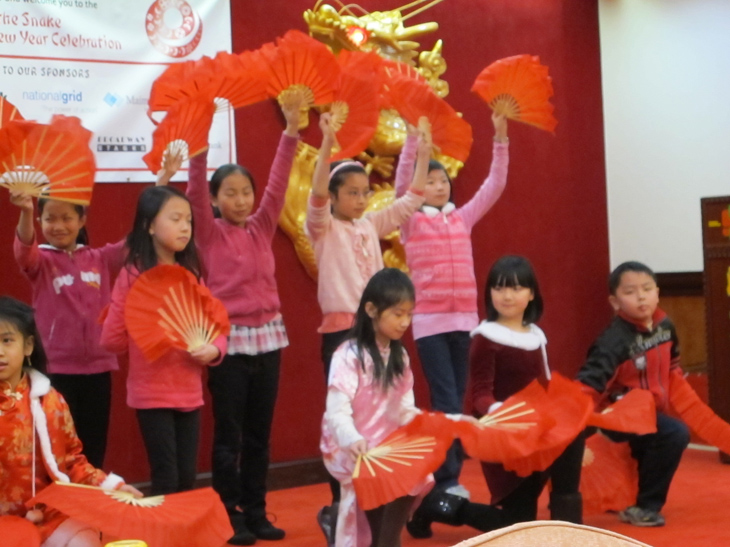
Children dancing at Chinese New Year’s banquet hosted by Marty Markowitz, Brooklyn Borough President.

I celebrated Chinese New Years in Brooklyn again this year. Hosted by Brooklyn Borough President Marty Markowitz, over 400 turned out for his annual Chinese New Year Banquet to benefit the Camp Brooklyn Fund. This year it was held at the New Spring Garden, an A-rated restaurant in Sunset Park on February 7.

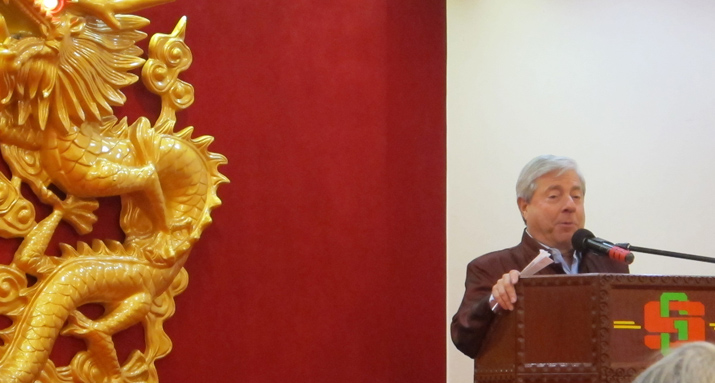
Marty Markowitz, Brooklyn Borough President opens Chinese New Year’s program.

Brooklyn’s Chinatown, located in the Sunset Park section, is the fastest growing Chinese community in the country, already surpassing Flushing, according to US Census reports. Marty Markowitz gave a rousing New Year’s greeting and saluted the achievements of this Chinese community for creating one of NYC’s best school districts and successful business districts. He also gave a special greeting and congratulations to Brooklyn Chamber of Commerce’s new Chair, Denise Arbesu, whose husband recently rolled off as outgoing Chairman. There were many officials, dignitaries, business leaders and sponsors in the room.

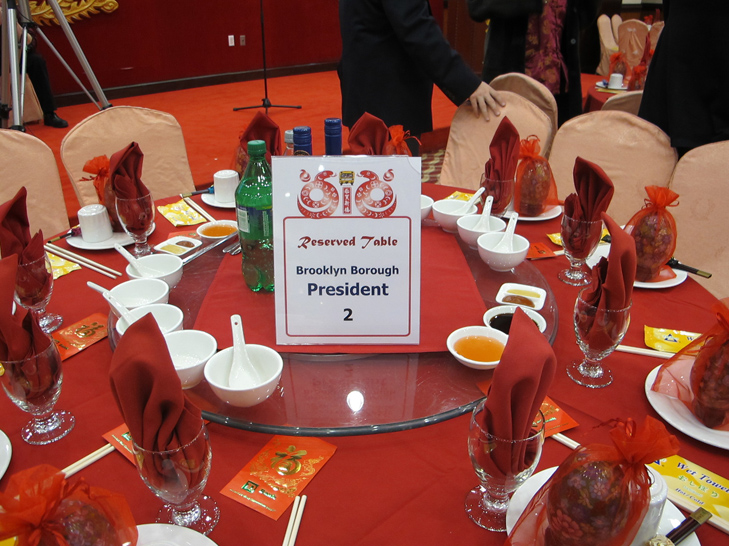
Brooklyn Chinese New Year’s banquet table setting at New Spring Garden.

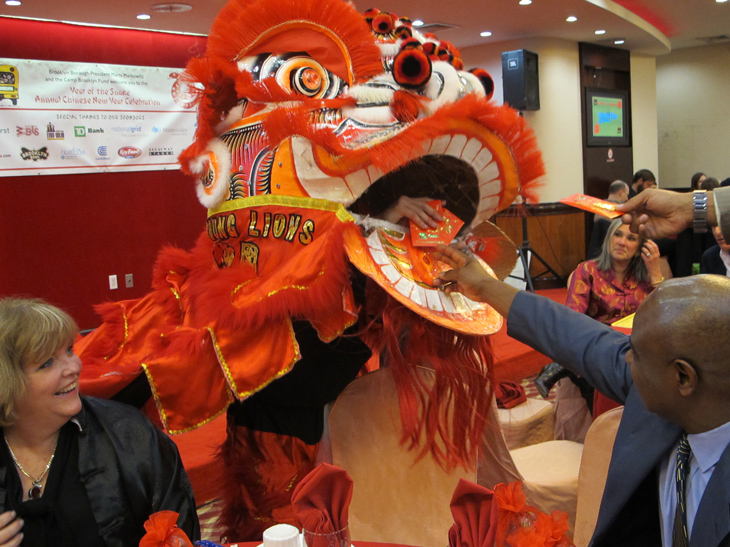
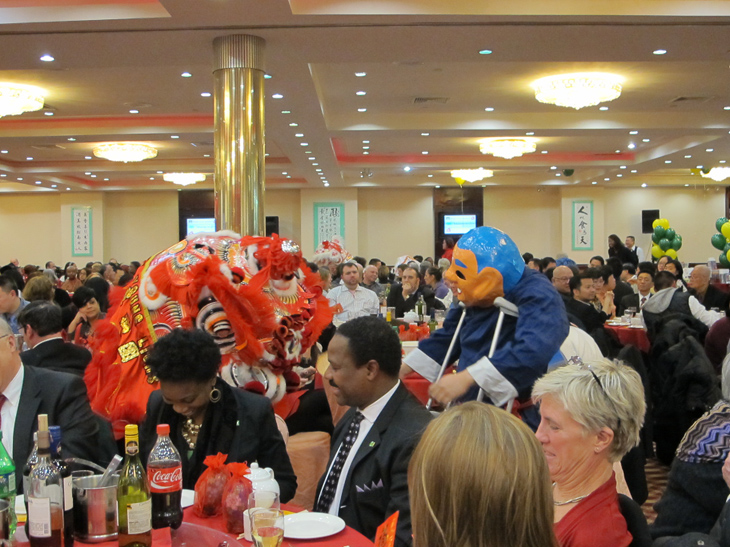
The program opened with children performing wonderful dances. The traditional dragon and its masked sidekick made its way around the huge dining room to drum beats and tambourines. Patrons excitedly “fed” the dragon’s mouth with red envelopes containing money for the Camp Brooklyn Fund.


Feeding the dragon at Chinese New Year’s banquet in Brooklyn’s Chinatown.

This was definitely an event that I should have worn my stretchy pants. We ate so much that I forgot to take photos of the food. But here’s the Menu: Appetizers: Steamed Shrimp Dumplings, Traditional Pork Dumplings; and Crispy Vegetable Spring Rolls. Soup: Marty’s favorite Velvet Chicken corn Soup with Homemade Fried Noodle. Entrees: Jumbo Shrimp with Honey, Walnuts and Sauce; Special New Year’s Grouper with Vegetables; Sizzling Beef over Bok Choy; Sweet and sour Spare ribs; New Spring Garden Sesame Chicken; Crowd Favorite Vegetable Fried Rice; Chicken Chow Fun Marty-Style; Sautéed String Beans in Garlic Sauce. Desserts: Fresh Sliced Oranges; Chinese Fortune Cookies. Beverages included White and Red wines and Tsingtao Beer.


The honorees were: Kenneth D. Daly, President of National Grid; Deon Livingston, Vice President & General Manager of WBLS & WLIB-FM; Michael “Buzzy” O’Keefe, Restaurateur Extraordinaire; and Yvonne Riley-Tepie, Vice President, US Field Marketing, TD Bank.


This year, we celebrate the Year of the Water Snake. Unlike Western culture, the snake symbolizes positive attributes in Chinese culture. The Snake is the intuitive, introspective, refined, cool and collected animal in the Chinese horoscope. They are attractive people who are graceful, exciting and dark all at the same time. They can become quite possessive when they set their minds on achieving the interest of a partner, according to some Chinese horoscope guides.


This is your year if you were born in: 1917, 1929, 1941, 1953, 1965, 1977, 1989, 2001, and 2013. Some famous Snake people include: Oprah Winfrey, John F. Kennedy, Abraham Lincoln, Martin Luther King, Jr., Pablo Picasso, Bob Dylan, James Joyce, Martha Stewart, Kanye West, Pierce Brosnan, Charlie Sheen, Courtney Love, Howard Stern, and Edgar Allan Poe, according to LA Examiner.


Dragon and masked sidekick winds their way around 400 diners at Brooklyn Chinese New Year’s banquet.

Celebration: If you feel like braving the cold weather, come out to celebrate Chinese New Years in Brooklyn’s Chinatown on Sunday, February 10. As usual, the Brooklyn Chinese American Association (BCA), a community service organization founded in 1987, organized this year’s festivities.

Schedule: 10 am-Noon performances by and for children, speeches, followed by firecrackers. Noon-1pm Parade from 50th to 60th streets. Visitors should go to 50th street and 8th avenue in Sunset Park area.

Directions: Take MTA, D train to 50th street, walk up hill four long blocks to 8th avenue. Make a day of it or go anytime. After the parade, explore the local area for New York’s best Chinese food and terrific local shopping.

Gong Xi Fai Cai, from my family to yours. Wishing you a prosperous Year of the Water Snake!

MLK Day

Celebrate National Day of Service in honor of Martin Luther King Jr.

MLK Day  or Martin Luther King Day is more than just a day. First Lady Michelle Obama wants us to take part in the National Day of Service in honor of Martin Luther King on Saturday, January 19, 2013.

“Four years ago, during his first inauguration, Barack and I were thrilled when thousands of Americans from every corner of the country took part in the National Day of Service honoring Martin Luther King, Jr. We were so excited because we knew that the celebrations weren’t just about a new president, but about everything that we can accomplish together. And that starts with service,” said First Lady Michelle Obama.

 “Everybody can be great because anybody can serve. You don’t have to have a college degree to serve. You don’t have to make your subject and verb agree to serve. You only need a heart full of grace, a soul generated by love.”—Rev. Dr. Martin Luther King, Jr.

The First Family is asking us to find an activity to serve others in our communities. Let’s get busy! There are seven ways to get involved: health, education, community resilience, economic development, veterans and military families, faith-based work, and environment.

Go to: http://action.2013pic.org/Pledge-to-Serve.

PS: When you click on the site and commit to serve, you will be automatically entered for a chance to attend President Obama’s Inauguration on January 21, 2013, flight and hotel expenses covered!