Drinking genes: Alcoholism in the family

Your genes determine whether you get drunk after drinking.

I wonder about drinking genes. Alcoholism seems to run in my family. Several of my relatives died from cirrhosis, an illness related to alcoholism. Thank goodness, I’m not much of a drinker. But my mom told me she worried that I might be at risk because I was born drunk. Well, truthfully, she was drunk when I was born. She said her excuse was that I took too long to be born. She said that she drank a full bottle of wine during her ninth month of pregnancy with me. Finally, I popped out several weeks overdue! I have always limited my alcohol intake because it makes my face and neck flush and my heart race. Knowing your family’s health problems, especially with alcohol, proves why genealogy is good for your health.

Scientists have proven that there are several genes related to alcohol metabolism.

“Multiple genes play a role in a person’s risk for developing alcoholism. There are genes that increase a person’s risk, as well as those that may decrease that risk, directly or indirectly. For instance, some people of Asian descent carry a gene variant that alters their rate of alcohol metabolism, causing them to have symptoms like flushing, nausea, and rapid heartbeat when they drink. Many people who experience these effects avoid alcohol, which helps protect them from developing alcoholism.” Click here to read more.

Book cover about underage drinking and peer pressure. Go to:http://www.thecoolspot.gov/

How do you know if your child will become an alcoholic? Key genes play a role in alcohol dependence.

“Today, scientists at the Scripps Research Institute announced they’ve identified a key gene that appears to strongly influence the development of alcoholism and alcohol dependence. The research could prove key to zeroing in on how increased risk for alcoholism runs in families. The study, published in Biological Psychiatry, sheds considerable light on genetic variations and how they predict who becomes dependent on alcohol and the severity of the disease. (Yes, alcohol is a disease.)”  To read more click here.

What about hangovers? Yes, there’s a gene for that too.

“Some people get hangovers after a night of drinking, while others don’t, and the reason may be in their genes, a new study of twins in Australia suggests. Researchers looked for links between the study participants’ genetic makeups and the number of hangovers the individuals reported experiencing in the past year. The results showed that genetic factors accounted for 45 percent of the difference in hangover frequency in women and 40 percent in men. Click here to learn more.

For a list of family illnesses caused by heavy drinking, click here.

Do you have drinking genes in your family?

Stories from stuff

Stories from stuff – Let go of your stuff with a story at a Show & Tell-NYC event Saturday, May 31, 5-7pm, @BuythatBag, 159 28th street, Sunset Park, Brooklyn.

Here’s an excerpt from my story:
“I refused to dump mother’s possessions at the curb. But, I could not keep anything. I was in a dilemma. I justified leaving the old trunk safely in the house just sold. Since the new owners were distant relatives, I left hoping that they might find something useful. Their eyes lit up!  They knew of mother’s superstitious habit of hiding her money. My inner artist had long been submerged by grief on that last day at mother’s house. Today, I would have easily found a way to keep some colorful fabric to make quilts, other creations and donate the rest.

Show&Tell-NYC, May 31, 5-7pm, @buythatbag,Brooklyn
Show&Tell-NYC, May 31, 5-7pm, @buythatbag, Brooklyn“I refused to dump mother’s possessions at the curb. But, I could not keep them. I was in a dilemma. I justified leaving the old trunk safely in the house just sold. Since the new owners were distant relatives, I left hoping that they would find some use for that old stuff. My inner artist had long been submerged by grief on that last day at mother’s house. Today, I would have easily found a way to keep some of that fabric to make quilts and other creations and donate the rest to charity.

Caribbean nick-knacks to donate

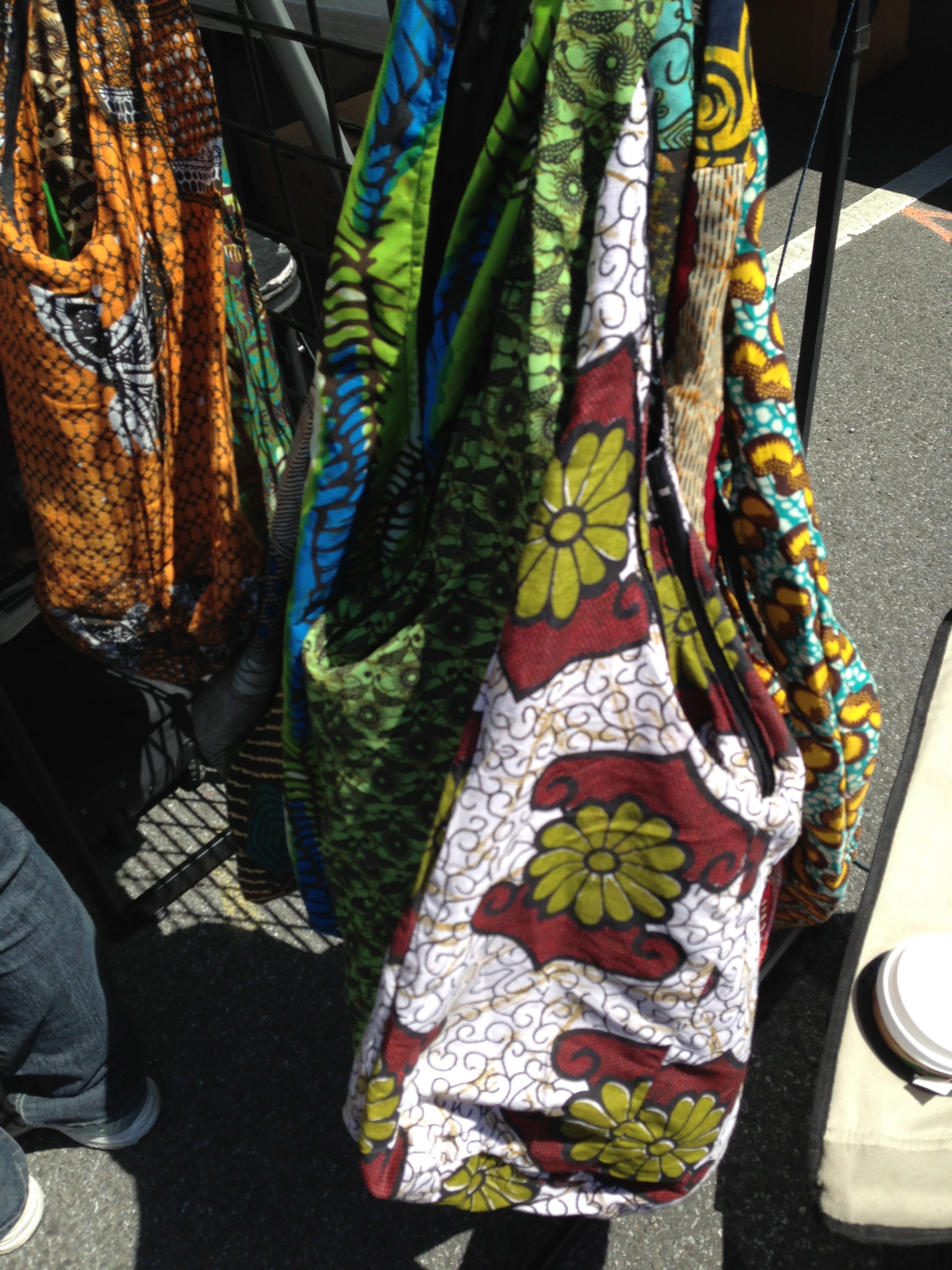
My mother told me that she inherited that old, heavy, wooden trunk from her mother. When my maternal grandmother arrived in Harlem from Trinidad, she found it on a sidewalk. She painted it with colorful flowers and it moved into her life.  My mother said that she used to sit and climb on it just as we did as children. That trunk moved with Grandma every time she moved—to various Harlem apartments, down to the Bowery, to 14th street, Chinatown, and eventually to our house on President Street in Brooklyn.  The trunk, now painted grey, was last kept in our basement. It was intermingled with my mother’s and grandmother’s things—vintage fabric and tapestries, sewing notions like zippers, snaps, hooks, buttons, beads and fibers including yarn, threads, twines, ribbons, sequins, lace, fringe, trimmings, tassels, and crochet, knitting, embroidery and art supplies. There were also nick-knacks, old greeting cards, and how-to booklets. My maternal elders were talented craftswomen who made everything with their hands—upholstery, apparel, costumes, rugs, curtains, quilts, pillowcases and other domestic items.” Excerpted from “Fabric of Our Lives,” published in my blog post March 12. 2013.

If you are de-cluttering, moving or simply letting go of your old stuff, tell a story about it at a grown-up  “Show & Tell” coming to Brooklyn – @BuythatBag, 159 28th street (Sunset Park), Saturday, May 31, 5-7pm. This event will benefit the Housing Works, an organization that helps HIV-AIDS survivors. Here’s the link for more information:

http://www.prnewswire.com/news-releases/show–tell-nyc-teams-up-with-housing-works-hwthrifts-259287471.html


Caribbean Mother’s Day

Caribbean Mother’s Day: I always marvel at mothers like my maternal grandmother Violet Chan Keong, who arrived in Harlem from Trinidad. She was newly divorced and travelling with three small children, including my mother. She left behind three older children.

Aunt Sybil, Agnes, Elaine in Trinidad
It took over a decade before my Trinidadian maternal Aunts Sybil, Agnes, and Elaine were reunited with their mother and siblings in NYC.

It would take more than a decade before they would reunite. Once settled in Harlem, my grandmother worked day, night, and weekends taking care of other people’s children and cleaning other people’s homes. She was very resourceful. Grandma came here to work.  Her side businesses included work as a seamstress, tailor, caterer and special events planner, especially Caribbean weddings. She taught me how to cook, clean, garden, sew, knit, crochet, manage events and read palms.

Like thousands of Caribbean mothers, Grandma Violet was motivated by the American dream. She saved every penny so she could send for her children and provide for the ones living with her. She did not worry about her daughters back home because they lived with our extended Caribbean family. Grandmother belonged to a unique network of tough West Indian mothers who learned by trial and error how to hold everything together in their cold new world.

Grandmother participated in a sou-sou, an old-fashioned Caribbean savings cooperative similar to a lottery.  A group of people deposited an equal amount of money for a period of time (monthly or bi-weekly) with a trusted banker in the circle. After that time was up, each person in the circle got a turn to keep the full pot.

Grandmother’s sou-sou and her extra jobs provided for all of the family’s needs—a new home, trips back to Trinidad and raising the children who lived with her.  Her generation did not believe in banks, loans or credit cards. Everything was about sacrifice and integrity! There were lots of letters and barrels sent back and forth between Trinidad, “BG”-British Guyana and New York. Articles such as clothing, fabric, sewing supplies, toiletries, books, magazines and traditional food and religious items were shipped on a regular basis. My elders shared everything in their tight-knit Caribbean community, especially precious news, letters and photos from back home. I inherited quite a collection of exotic postal stamps, news clips and photos from that time.

Most importantly, I learned about my family’s cultural history —from our mother and grandmother’s stories. With each barrel sent and each new arrival from the old country, there were stories, photos and new chapters about Trinidad and Guyana’s independence. I was a teen when my Aunt Elaine, my mother’s oldest sister, arrived in NY. I was given her name as my middle name. Aunt Elaine’s son William lived with us in Brooklyn while he attended Howard University. I can recall the scene. There they were, sisters meeting for the first time–laughing and crying tears of joy. Circumstances, family drama, post-colonial politics and immigration laws were some of the reasons for this belated reunion. So, on Mother’s Day, I give a special salute to Caribbean mothers everywhere for your courage and sacrifices to start a new life. Check out how Mother’s Day is celebrated around the world: http://time.com/94286/mothers-day-2014-world/


Show business genes

Show business genes – I attended a fantastic show recently called “On Kentucky Avenue – The Club Harlem Revue,” that brought back memories. It was a story about an historic African American nightclub in Atlantic City (AC) where several of my relatives performed. Club Harlem was considered the ‘Black Copacabana’ of its time–among the best of the Chitlin’ Circuit! Besides cooking genes, there seems to be a lot of show business genes in my family, especially on my father’s side (Harlem via New Orleans and Mississippi). If you were born with showbiz genes, being a performing artist or working in the entertainment industry is probably the only thing you can do or want to do. Maybe we could also call it diva or divo genes! Is the world your stage? Are you prone to drama if the right music or circumstance presents itself? If you can answer yes to any of these questions, then chances are that you were born with showbiz genes. I am related to a lot of characters like that. Even if they are too old or infirmed to dance, sing and perform, they still do. When my jazzy cousin Tempy was in her eighties she would perform high kicks and splits just to let you know she still had it! Cousin Jojo Smith at 70+ had two hip replacements and still choreographs, coaches and teaches.

Atlantic City was the Gold Coast for the rich, white international set. Films and songs have been written about this iconic seaside town. I assume that the owner of AC’s Club Harlem added the name “Harlem” to his club’s title because it gave his place the global brand for great black entertainment. The validity of AC’s Club Harlem was that it gave talented artists of color like my relatives another place to perform in the region besides the ‘real’ Harlem, other Chitlin’ Circuit venues and Europe. Like the ‘real’ Harlem in New York City, Atlantic City was racially segregated back when my relatives performed there. My Aunt Jeri Smith, was a pianist and bandleader; Uncle Joe and Aunt Helena Smith had a tap dance routine with Cab Calloway; and cousins Jojo Smith, Tempy Fletcher and Kathy Smith were dancers with the Lon Fontaine Trio, Larry Steel Dancers and in “Rio” and “Mambo” acts. They told stories about performing on the same night with such greats as Dinah Washington, Sammy Davis, Duke Ellington, Louie Armstrong, Lou Rawls, Sarah Vaughn, Gladys Knight, Ella Fitzgerald, The Hines Brothers, Moms Mabley, Slappy White and too many to list here.

Aunt Jeri said that black artists were always booked as performers and entertainers in the big Atlantic City venues. But because of race laws, blacks could not enter these fancy establishments. So, they needed someplace else to go ‘after-hours’  to unwind.  Can you imagine? After receiving standing ovations, the black stars had to exit through the back door. As fans clamored for their autographs, security guards harassed them until they left for AC’s all-black section on Kentucky and Missouri Avenues, a few blocks away.

Well, once inside Club Harlem on Kentucky Avenue that’s where the ‘real’ shows happened, according to family stories.  Club Harlem became THE after-hours venue for the hottest shows in AC. Many of the big white stars like Frank Sinatra, the Rat Pack, and Marilyn Monroe and others would hangout with the black stars and patrons there.

There is a Smithsonian Institute exhibit about Club Harlem in the works to tell this unique chapter of African American music history. Here’s link: http://www.atlanticcityweekly.com/news-and-views/local-history/Got-Club-Harlem-smithsonian-exhibit-museum-music-history-ac-139380708.html

The recent show (2/17/2014) portrayed a wonderful spin about an original place that had closed years ago. Set during an era when entertainers had an elegant soulful style rarely seen today, there was one fabulous act after another.  The stories within a story involved a 1969 opening night and a love triangle. I am certain that everyone in this cast was born with showbiz genes! There was plenty of drama, theater, dance and original music that brought everyone to their feet and dancing in their seats. Check listings for upcoming shows at www.onkentuckyavenue.com.

The awesome cast included, in order of appearance: Ty Stephens, Cheryl Freeman, Andrika Hall, Mindy Haywood, Brian Davis, Cassandra Palacio, Renee Ternier, Adam Bourque, Donna Clark, Gregory J. Hanks, Lee Summers. Guest star and Creator, Jeree Wade; Director Adam Wade; The Freddie Baxter Orchestra: Frank Owens, piano; Richard Cummings, synthesizer; Damon Duewhite, drums; and Wilbur Bascomb, Odell Craft-Bass.

Do you have showbiz genes in your family? Do tell!

Here are some photos from my family archives and event photos taken from a recent show at The Triad Theater, 158 West 72nd Street, 2nd Floor, NYC.

Music Genes: Madame Tempy

Music was key to my family’s survival, according to stories I heard since childhood. Our music genes were inherited from my paternal grandmother, Madame Tempy (Stuart) Smith, (1884-1960) the family matriarch. She was born and raised on a dairy farm in Ocean Springs, Mississippi, two generations from slavery. Despite racism, lynchings, and segregation, Madame Tempy managed to acquire a college education at Straight College now known as Dillard University and the Boston Conservatory. She developed an exceptional reputation as a music teacher and performer in Ocean Springs and New Orleans, according to news clips and family stories.

After filing for a divorce, Madame Tempy (sometimes spelled Tempe) singlehandedly raised her large family of talented musicians, singers and dancers. An extremely independent, self-reliant and perceptive person, she recognized her family’s perilous living conditions. Like the Sound of Music’s Von Trapp family that escaped the Nazis, Madame Tempy turned her young, talented brood into a musical group and quietly escaped the South. The difference between my family and the Von Trapp’s was that they were not told that they were escaping or that they were part of America’s largest, historic migration! Driving a funny-looking, packed automobile, my family followed the legendary “Chitlin Circuit.” They performed in many venues both large and small from Mississippi all the way to Harlem.

Madame Tempy’s musical and business skills were fully realized when she joined others who were part of the Harlem Renaissance. A courageous person with a dictatorial personality, she became a real estate entrepreneur, sacred music composer, and legendary piano teacher. With every Harlem apartment building that she purchased a music school was set-up, and rehearsal studios and rooms were rented. She employed all of her children, nieces, nephews and many extended family members.

My aunts and uncles continued in show business and became teachers too. My Aunt Jeri Smith, who drove the getaway car, gave piano lessons when she was not leading her own orchestra, touring Europe or performing in Hollywood films. My Uncle Joe Smith, my father’s baby brother, was the star of the family’s traveling show. He was the Sammy Davis and the  ‘Michael Jackson’ of the family act. A talented tap dancer, singer, and musician, Uncle Joe was called a five-year-old “wizard drummer,” in a New Orleans newspaper.

It was a tradition for the older cousins to tutor the younger ones. My older cousin Sonny Brigman mentored me on the nuances of Beethoven’s piano Sonata Pathetique. I also trained on the viola. My whole family was musical including my mother, father, sister and two brothers. We played piano, violin, guitar, percussion and wind instruments.

I wish the younger generation of nieces, nephews, and cousins could have met their elders. Because of segregation and racism, we were a tight-knit family. Thanks to racial integration, the family has spread out all over the world. I am still digging for musical genes in my family both past and present.

Do you have music genes in your family?