Off-Broadway Harlem show

I attended Opening night recently of Buried Child, a Sam Shepard Revival at Aaron Davis Hall at City College in Harlem. Here’s an excerpt, with additional photos not included in my review, as published on Examiner.com:

BURIED CHILD — Khalil Kain directing “Buried Child” by Sam Shepard at Aaron Davis Hall, which  presented the play in an Off-Broadway production July 11 to August 3. Photo by Jingxi Zhang.

Actor Khalil Kain, known for character roles in films and as Darnell Wilkes on the TV series Girlfriends, made his directing debut recently with an Equity LORT/LOA production of Sam Shepard’s Buried Child.  The show runs through August 3, Aaron Davis Hall, at Harlem’s City College campus.

A racially mixed cast interpreted Shepard’s 1979 Pulitzer prize-winning play about a once prosperous but now dysfunctional Midwestern farm family. The play’s deep, dark secrets reveal incest, murder and multiple personality disorders. When grandson Vince makes a surprise visit with his girlfriend, Shelly, their presence sets off a series of revelations. A haunted house springs to life with Shelly, Vince and his grandpa, Dodge, who does not recognize him. You wonder what’s going to happen next. The ending may knock your socks off!

The cast included: Robert Boardman, as Dodge; Teresa Anne Volgenau, as Halie; Eric Gravez, as Tilden; Stephen Macari, as Bradley; Teniece Divya Johnson, as Shelly; Leroy Smith Graham, as Vince, and Edwin Matos, Jr., as Father Dewis. Set design is by Arnold Bueso. Lighting design is by Brian Aldous. Costume design is by Mary Myers. The production also included: Stage Manager, Reginald L. Wilson; Assistant Stage Manager, Stephanie Peralta; Assistant to the Director, Brandon Baskin; Hair & Makeup, Brandalyn Fulton; and Production Assistant, Michael Aponte; Khalil Kain, director.

Tickets are $25 general admission; $10 seniors and students (with ID). Performances run through August 3 on the following schedule: 7 p.m. Thursdays and Fridays, 2 p.m. and 7 p.m. Saturdays. Call the box office (212) 650-6900. For online tickets go to: www.adhatccny.org. Aaron Davis Hall is located at 135th Street and Convent Avenue, on the City College of New York campus. Subways are #1 to 137th Street; C to 135th Street, or A or D to 145th Street. Free parking is available in the South Campus Parking Lot (enter at 133rd Street and Convent Ave).

BURIED CHILD — Aaron Davis Hall will present an Off-Broadway production of “Buried Child” by Sam Shepard, directed by Khalil Kain, July 11 to August 3, 2013. (L) Robert Boardman as Dodge, (R) Eric Gravez as Tilden. Photo by Jonathan Slaff


Cast of Buried Child have fun pose at post-Opening Night Reception.

Genealogy is Good for Your Brain

Genealogy is good for your brain! I stumbled across a study done in Berlin that seems to prove that genealogy increases brainpower. Thinking about our ancestors can boost performance on intelligence tests creating something called an “ancestor effect,” according to the European study.

Maternal grandmother’s sister Aunt Emily and Uncle Mansing pose in Trinidad.

“Anecdotally, there’s reason to believe that such thoughts (thinking about where we came from – our ancestors) are beneficial. Why else the public fascination with genealogy and programmes like the BBC’s Who Do You Think You Are? Now Peter Fischer and his colleagues at the Universities of Graz, Berlin and Munich have shown that thinking about our ancestors boosts our performance on intelligence tests – what they’ve dubbed ‘the ancestor effect’.”

Read more about it in the British Psychological Society’s Research Digest Blog at: http://bps-research-digest.blogspot.com/2010/12/benefits-of-thinking-about-your.html.

What happy good news! I have always felt that the genealogists were smarter than most people. So, here’s some scientific proof to back up that claim.  I mean, what profession requires one to be an historian detective organizing, analyzing, and interpreting data and using the brain in so many different ways? Genealogy is a multidisciplinary pursuit that demands insights into many areas including history, psychology, sociology, biology, genetics, geography, languages, problem solving, logic and mathematics.

Do you think about your family history? Have you tried to do genealogy searches for anyone? Great. Your are brilliant!

My Fat Genes

With Kim Nemoy, my baby sister, on right

My baby sister was always bigger than me. She takes after my father’s people. The women on his side are thick and full-bodied.  Why are they big? One answer is: Good food leads to eating a lot. I always blamed our Mississippi and Louisiana heritage for developing our famous cooking genes! I mean, who invented Southern cuisine? Not Paula Dean! But, more on our cooking genes later.

Actually, many of us inherited fat genes from our ancestors—a genetic disposition for obesity. One in every seven Americans were born with the fat gene! Mexico recently surpassed the US as the  “world’s most obese,” according to a United Nations report. But are you destined to be fat if your family is fat? Scientists say No! You can prevent obesity by exercising and eating healthy food.

Furthermore, British scientists recently gained a deeper understanding about a fat gene called “FTO,” that causes our “hunger” hormones to crave certain foods more than others.

“A version of an obesity gene, called FTO, had been linked to a bigger belly, but the reason why was uncertain. A study, published in The Journal of Clinical Investigation, showed it made fatty foods more tempting and altered levels of the hunger hormone, ghrelin. Obesity experts said drugs targeting ghrelin might reduce weight gain.

Read more about it:

http://www.bbc.co.uk/news/health-23312712

In my family there were several heart attacks and strokes. As we know, obesity is a high risk factor for diabetes, heart disease and certain cancers. At least 2.8 million adults die each year as a result of being overweight or obese. More than 40 million children under the age of five were overweight in 2011, according to the World Health Organization.

Let’s face it. All of us may gain a few pounds now and then. And, we really can’t blame our extra weight on any single factor: genetics, nature, nurture, and environment. In terms of the environment, if you live in New York City, you are more likely to walk and take public transit than folks living in other places where they mostly drive. Obesity is caused by a combination of factors.

view of man’s fat belly sitting on park bench.

So, let’s not wait for pharmaceutical companies to develop new obesity drugs based on our fat genes.  Instead, let’s eat better, cook healthy, walk and exercise more and prayer helps too! Does the fat gene run in your family?

Genealogy is Good for Your Health

Smith family gathering in Brooklyn.

At a recent family gathering a cousin criticized my genealogy passion: “Why are you looking back? You should be looking forward,” she said.  As a genealogist, I gasped. But it took only a moment to re-group. Here was a teachable moment! Timing must be right in order for learning to happen. A simple conversation began. The dialogue that we had became the best way to explain how genealogy ie. family history could be good for your health–mind, body and soul!

Did you know that the more you know about health conditions and traits that run in your family, the healthier you can be? Genealogy is also good for your emotional, spiritual and psychological health! But, more on that in future postings.

Start talking: The best way to start your genealogy health journey is to start talking with the living. Today, even if you are adopted, you can find your family history by taking a DNA genealogy test to find relatives. At the reunion, we started by talking about family traits and cultural traditions passed down. One of the traits we discussed was left-handedness. Our mother was born left-handed. But because of her family’s cultural taboos, she was forced to become right-handed. And, three of her four children were born left-handed!  We also talked about other traits like hair texture, body types and ethnic mixtures found on both sides of our family.  All of these topics, especially ethnicity and cultural backgrounds are relevant to your health and should be discussed by your health care provider.

Ten Questions to Ask at Family Reunion:

  1. What traits run in our family? eg. dimples, twins, eyes or hair color, freckles, attached earlobes, toe lengths, artistic, musical, mechanical, athletic abilities.
  2. What health problems run in our family?
  3. How old were family members when diagnosed with an illness?
  4. What conditions caused death in our family? Who was the oldest in our family?
  5. Any pregnancy losses?
  6. Any birth defects, mental illness, or developmental disabilities?
  7. What is the ethnic make-up of our family?
  8. Where does our family come from? (country, regions)
  9. Lifestyle queries: smoking; where did family members work, list occupations; did they work on a farm, factory, outdoors; obesity or extremely thin; drug, alcoholism problems?
  10. Any allergies to foods or medication?

Tool Kit for Family Health History:

Here’s a link to a tool kit with important facts, ideas and activities to help you document your family history, published by Utah Department of Health: https://familyhistory.hhs.gov/fhh-web/familyHistory/start.action

Genealogy Resources: The following records can help you learn what your living relatives may not know about your family history:

  1. Death certificates-includes cause and date of death of an ancestor; may include diseases, conditions of concern during a specific historic era.
  2. Funeral Home Records – funeral programs, files might name relatives assisting and providing family information.
  3. Obituaries – checking old newspapers can net amazing details especially if there was an accident or a crime.
  4. US Census– check for age of parents, children born to older parents, large gaps between births; many relatives living together; certain occupations can impact health, like coal miners.
  5. Religious Records – and church bulletins also include clues about a specific community and the person’s health condition.

Oldest in the Family

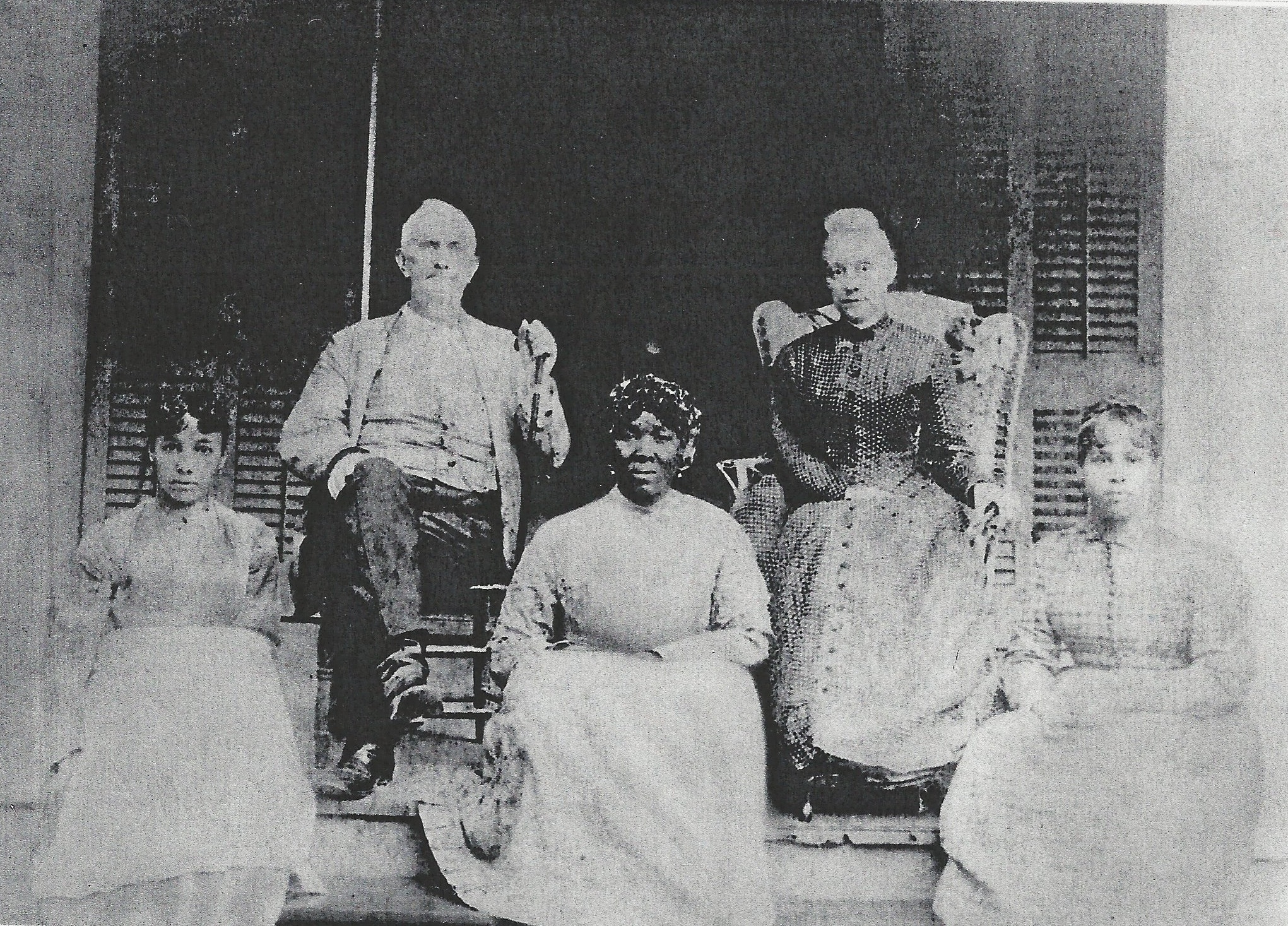
My paternal great-great-great-grandmother, Tempe Burton, on porch w/ two mulatto daughters sitting w/Col. W.R. Stuart & wife, Lizzy. Tempe lived to 104 years old!

Who’s the oldest in your family? My husband and I met a group of baby boomers aboard a Natchez steamboat on the Mississippi River during our recent anniversary trip to Louisiana. It was obvious that they were on a family reunion trip. They all wore “Robinson Family” T-shirts. Our conversation naturally turned to –“Who was the oldest in their family/” and ‘How many generations could they trace?”

The feistiest lady in this African-American group said that she was the oldest on this trip at 78. She said that she could trace back to three generations. She also said that their oldest family member, great-Aunt Mamie Robinson, is 100 and lives in Georgia!

The friendly lady shared anecdotes about family as the others chimed in with affirmatives: “Old Auntie works in her garden everyday, cans all of her home-grown summer vegetables, and chops wood. She is what we call a ‘busy body.’ Folks drop in on her all day long. She especially likes the latest gossip. She tells funny stories too.  But Auntie always talks about hard work, whether folks had good manners and was ‘raised right’. ”

The lady explained that their family is spread out all over the globe now and that they had reunions in a variety of cities. “We’re the ‘old-school’ cousins. We have a tradition of coming to New Orleans for vacation since we were kids. So, here we are!” she said.

“Why do old people matter today?” I asked.  “Wisdom!” said the only man in the group. “Old people teach the young people their family history. Maybe they would have better sense if they knew what the earlier generations went through to survive!” said another spry boomer.

I believe that the oldest person in my family was Tempe Burton, a former slave. My genealogy buddy/cousin, Snow Fox Lawrence, shared an old newspaper clipping about our paternal great-great-great grandmother who lived to 104 in Ocean Springs, Miss!

Here is an obituary of my great-great grandmother Tempe Burton in a March 1925 Ocean Springs, Mississippi newspaper:

“Aunt Tempe Burton, the oldest person in Jackson County, died Sunday at the home of her son Alf Stewart. The funeral was held Monday afternoon and was largely attended by both white and colored friends. Tempe was said to be 104 years of age. She was an ex-slave and had made her home with the late Mrs. W.R Stuart for seventy years. When Mrs. Stuart was married, Aunt Tempe was given to her as a wedding gift and was Mrs. Stuart’s maid. When slavery was abolished she refused to leave her mistress and remained with her until the end. Mrs. Stuart died about two months ago.”

Who is the oldest person in your family? Where do/did they live?

I posed this question to new friends at a Blogging While Brown conference. Check out their amazing entries:

Miz Kp -“The oldest person in my family is my grand aunt. She was born in 1919. She is 94 and lives in Chesapeake, VA.”

April J. Cheatam Sands – “My great-grandmother lived to be 98 and died in 2006 in Wilmington, NC (born in 1907).”

Gina McCauley-  “I had a paternal great-grandmother that lived to 99. I have a cousin in Houston, TX that is 100+ year’s old. They do a story about her in the local news every year. My maternal grandmother lived until she was 93!”

Kahlil O. Haywood – “My grandmother is the oldest in my family. She’s 95.  She’s still alive. She’s from Panama, lives in Brooklyn.”

Lashuntrice Thestoryteller Bradley – “My great-grandmother is 86 and lives in Florida, born in Georgia.”

Alysia Christiani – “My paternal grandmother lived to 100. She was from Guyana, South America but died in Brooklyn, New York.”

Erica Kierulf – “My grandmother was born in Blue Fields, Nicaragua. Lived to 105. She resided in Chicago, IL.”

Deborah Smikle-Davis – “My wonderfully creative and inspiring paternal grandmother, Lillie Mae, lived to be 95. She resided in Lumberton, NC.”

Eva Greene Wilson – “Great-grandmother in Tobago lived to 104. I think she’d have lived longer if she hadn’t lost her sight and mobility. Being able to get up and down the hill to be “in people’s business” was what really kept her going.”

Who’s the oldest in your family? Do tell!