BBC Radio Academy Award-Gold!

I am honored to announce that the BBC Radio program featuring my interview and storytelling among others, recently received the prestigious BBC Radio Academy Award-Gold Award for “Strange Fruit,” produced by Maggie Ayre.

Congratulations to the amazing producer Maggie Ayre and the awesome storytellers on the show. After reading my story on the Coming to the Table website about my Uncle Warren’s lynching, BBC Radio producer Maggie Ayre invited me to join her Soul Music program. The show also included Emmett Till’s cousin, Simeon Wright; Robert Meeropol, the adopted son of Jewish teacher Abel Meeropol, author of the poem/song; and April Shipp, a Detroit quilt maker who created a “Strange Fruit” quilt. Each of us engaged about the song, “Strange Fruit” and shared our own personal story.

radio
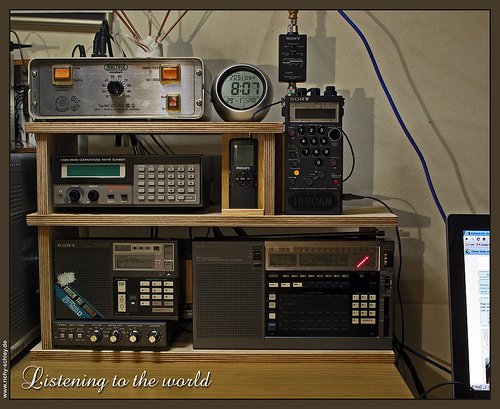
What kind of radio do you listen to?

What the judges said about  “Strange Fruit”:

“Using a simple format with moving interviews, this was immensely powerful storytelling through and about music. It allowed the lyrics to breathe, resulting in an impactful and brilliant show. This was ‘stop and listen’ radio.”

Here’s the link to BBC Radio Academy Award announcement: http://www.radioacademyawards.org/winners/index.cfm?winners_year=2014&winners_award_group_id=4&winners_award_category_id=21

“Strange Fruit” Headed to the Theater Stage: In addition, this amazing radio program inspired a theater production in England. Anyone want to join me for a trip to the UK this summer? I was only given bare details at press time. I received word second-hand from the producer that he is going ahead on July 10th at the Wirral Festival of Firsts. For updates, go to:  http://www.festivaloffirsts.com/home/4582210171.

To hear the original BBC broadcast, check out a past blog post by clicking here.


‘Promises Kept’ a Toolkit for Raising Black Boys

Promises Kept-Raising Black Boys to Succeed in School and In Life is the companion book to the documentary American Promise Project that explores black male achievement gaps. When two black boys get accepted to New York’s prestigious Dalton School, we witness the promises and problems of thriving and surviving in an elite school. It became very clear that no matter how wealthy or poor you are, if you have a black son, you will see gaps in almost every area of his life from school test scores to his emotional, social and physical wellbeing. This book is essentially a toolkit on how to raise your black boys for success with provocative chapters like: “You Brought Him into this World, Don’t Let Other folks Take Him Out: How to Discipline Our Sons for Best Results” and “Protect Him From Time Bandits: How to Teach Our Sons to Manage Their Time.”

Why do achievement gaps happen to our boys? These are some of the questions asked and answered by the film and book. Written and produced by an Ivy League-educated black parent team Joe Brewster, MD (Harvard), and Michele Stephenson (Columbia) with Hilary Beard, this book provides strategies and lessons learned.

The documentary filmed two boys–the couple’s son and his best friend– from grade school to Dalton, home, the Clinton-Hill/Fort Green Brooklyn community and various activities. Some viewers scoffed at the parents for treating the children as an experiment for their film. But what emerged was a raw portrait of life inside of two very engaged black families and their efforts to instill the light of learning.  As we witness these little boys become young men, we can see that despite everyone’s best efforts, their potential for success is constantly eroded by forces all around them. Thankfully, today, the boys are both college sophomores.

I commend this book for the quality of its research, analysis and accessible writing. This is the first “how to” book on raising black boys that I ever read. I suspect that some parents and caretakers will wish they had read it before raising their grown sons. Not many parents can film their children’s daily lives to create a documentary. But these parents did.  They did us a favor. This was another wake-up call!  Teachers, we must not give up on black students! Black parents and community, we must continue our vigilance! If we take a pass on our son’s education, the most likely place for black boys with no grounding in family, education or positive community, is the penal system, according to most experts. Click here for book excerpt.

Internships 2014

internships 2014 – NYC multicultural media

Qualifications: Exposure to documentary production and publishing; strong writing, editing, genealogy, archival research skills; Blog experience, Twitter, Pinterest, Tumblr etc.  Students of film, multimedia, journalism, or computer science preferred; must also have strong multicultural interest: African American, Caribbean, Asian culture especially food, culinary history, arts and entertainment. Must be a full-time matriculating student in a BA or MA university college degree program.  This post will be listed at Ivy League and CUNY schools including Barnard College, Columbia University, New York University, Hunter College, Brooklyn College, Smith College, Amherst College, and Mount Holyoke.

Duties: Assist with blog maintenance, widgets, plugins, updates; assist original documentaries and media campaigns. Focus areas include multicultural engagement, genealogy, food, environment, travel, entertainment, social change, philanthropy. Training provided on how to conduct oral history, news interviews. Interns will provide support for editorial projects , special events and administrative tasks.  Interns have an opportunity to conduct original research and coordinate all aspects of documentary production from pitching story ideas to developing film narrative, webisode, video, conduct photo & video shoots, gathering of editorial, archival photos and video materials, script writing, conducting and transcribing audio interviews. Interns must take ‘ownership’ of assigned projects. Opportunities to build a portfolio, resume, ‘shadow’ and be mentored by top media industry leaders. Interns should be able to work independently organizing visual, sound elements, basic story research, fact-checking. Must be results-oriented, have a desire to learn, possess excellent follow-through, good with details and great people skills. Opportunities to improve photo, video camera, audio, sound, graphic arts, new media and IT skills.

Locations: Lower Manhattan, Brooklyn, Harlem, Queens, Bronx.

How to apply: Submit resume with short cover letter (five sentences) on how you can help our mission. Include links to your blog and website to jobs@Yonarrative.com.

Deadline: ongoing beginning September 2014

Tent Start Date: ongoing (6 weeks)

Contact: Sylvia Wong Lewis (Smith College alum), email to: jobs@YoNarrative.com

No phone calls please.

Show business genes

Show business genes – I attended a fantastic show recently called “On Kentucky Avenue – The Club Harlem Revue,” that brought back memories. It was a story about an historic African American nightclub in Atlantic City (AC) where several of my relatives performed. Club Harlem was considered the ‘Black Copacabana’ of its time–among the best of the Chitlin’ Circuit! Besides cooking genes, there seems to be a lot of show business genes in my family, especially on my father’s side (Harlem via New Orleans and Mississippi). If you were born with showbiz genes, being a performing artist or working in the entertainment industry is probably the only thing you can do or want to do. Maybe we could also call it diva or divo genes! Is the world your stage? Are you prone to drama if the right music or circumstance presents itself? If you can answer yes to any of these questions, then chances are that you were born with showbiz genes. I am related to a lot of characters like that. Even if they are too old or infirmed to dance, sing and perform, they still do. When my jazzy cousin Tempy was in her eighties she would perform high kicks and splits just to let you know she still had it! Cousin Jojo Smith at 70+ had two hip replacements and still choreographs, coaches and teaches.

Atlantic City was the Gold Coast for the rich, white international set. Films and songs have been written about this iconic seaside town. I assume that the owner of AC’s Club Harlem added the name “Harlem” to his club’s title because it gave his place the global brand for great black entertainment. The validity of AC’s Club Harlem was that it gave talented artists of color like my relatives another place to perform in the region besides the ‘real’ Harlem, other Chitlin’ Circuit venues and Europe. Like the ‘real’ Harlem in New York City, Atlantic City was racially segregated back when my relatives performed there. My Aunt Jeri Smith, was a pianist and bandleader; Uncle Joe and Aunt Helena Smith had a tap dance routine with Cab Calloway; and cousins Jojo Smith, Tempy Fletcher and Kathy Smith were dancers with the Lon Fontaine Trio, Larry Steel Dancers and in “Rio” and “Mambo” acts. They told stories about performing on the same night with such greats as Dinah Washington, Sammy Davis, Duke Ellington, Louie Armstrong, Lou Rawls, Sarah Vaughn, Gladys Knight, Ella Fitzgerald, The Hines Brothers, Moms Mabley, Slappy White and too many to list here.

Aunt Jeri said that black artists were always booked as performers and entertainers in the big Atlantic City venues. But because of race laws, blacks could not enter these fancy establishments. So, they needed someplace else to go ‘after-hours’  to unwind.  Can you imagine? After receiving standing ovations, the black stars had to exit through the back door. As fans clamored for their autographs, security guards harassed them until they left for AC’s all-black section on Kentucky and Missouri Avenues, a few blocks away.

Well, once inside Club Harlem on Kentucky Avenue that’s where the ‘real’ shows happened, according to family stories.  Club Harlem became THE after-hours venue for the hottest shows in AC. Many of the big white stars like Frank Sinatra, the Rat Pack, and Marilyn Monroe and others would hangout with the black stars and patrons there.

There is a Smithsonian Institute exhibit about Club Harlem in the works to tell this unique chapter of African American music history. Here’s link: http://www.atlanticcityweekly.com/news-and-views/local-history/Got-Club-Harlem-smithsonian-exhibit-museum-music-history-ac-139380708.html

The recent show (2/17/2014) portrayed a wonderful spin about an original place that had closed years ago. Set during an era when entertainers had an elegant soulful style rarely seen today, there was one fabulous act after another.  The stories within a story involved a 1969 opening night and a love triangle. I am certain that everyone in this cast was born with showbiz genes! There was plenty of drama, theater, dance and original music that brought everyone to their feet and dancing in their seats. Check listings for upcoming shows at www.onkentuckyavenue.com.

The awesome cast included, in order of appearance: Ty Stephens, Cheryl Freeman, Andrika Hall, Mindy Haywood, Brian Davis, Cassandra Palacio, Renee Ternier, Adam Bourque, Donna Clark, Gregory J. Hanks, Lee Summers. Guest star and Creator, Jeree Wade; Director Adam Wade; The Freddie Baxter Orchestra: Frank Owens, piano; Richard Cummings, synthesizer; Damon Duewhite, drums; and Wilbur Bascomb, Odell Craft-Bass.

Do you have showbiz genes in your family? Do tell!

Here are some photos from my family archives and event photos taken from a recent show at The Triad Theater, 158 West 72nd Street, 2nd Floor, NYC.
BBC Radio: ‘Strange Fruit’

Sylvia Wong Lewis, Narrative Network founder, is featured on BBC Radio program Soul Music, on an episode called “Strange Fruit.” Producer Maggie Ayre, looks for stories behind music with powerful emotional impact. Concerned that UK audiences may not know about lynching, Jim Crow laws and other harms that resulted from the Trans-Atlantic slave trade, Maggie decided to take another look at this protest song.

Maggie found me through my slavery group–Coming to the Table, and invited me to join her Soul Music program with Emmett Till’s cousin, Simeon Wright; Robert Meeropol, the adopted son of Jewish teacher Abel Meeropol, author of the poem/song; and April Shipp, a Detroit quilt maker who created the “Strange Fruit” quilt. Each of us was asked to engage about the song, “Strange Fruit.”

“First recorded in 1939 by Billie Holiday, the protest song Strange Fruit came to symbolize the brutality and racism of the practice of lynching in America’s South. Now, decades later, such is the song’s enduring power that rapper Kanye West sampled the track on his latest album “Yeezus.” – Maggie Ayre, Producer, Soul Music, Radio 4, BBC News, Entertainment & Arts.

“The smell of the honeysuckle brings all of it back. That’s the smell prevalent in the area where we lived. The honeysuckle was in bloom. Because words can’t describe how we felt that night. How I felt. It was a combination of grief, shock, and fear. You have a sorrow that grips you because of what happened to Emmett.” – Simeon Wright, Emmett Till’s cousin.

Click here to read the full story: http://www.bbc.co.uk/news/entertainment-arts-25034438

To listen to BBC Radio program, click here for the webpage in advance of the Tuesday, November 26, 2013, broadcast of Soul Music. Look on the Gallery section for photos of radio show guests:

http://www.bbc.co.uk/programmes/b03jb1w1