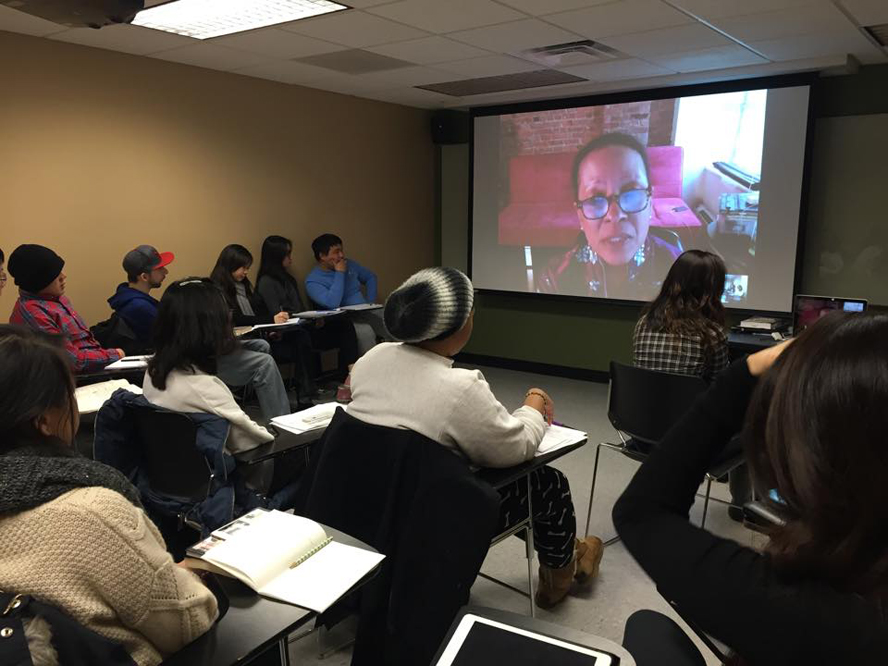
I was a Guest Lecturer at Binghamton University (SUNY) recently, where I presented to a History and English departments multidisciplinary course called “Chinese in the Americas.” Professor Lisa Yun, a noted historian and author of the landmark book “The Coolie Speaks-Chinese Indentured Laborers and African Slaves in Cuba,” presided. My film “From Shanghai to Harlem,” (on Youtube) was shown as a vehicle to drive discussion about lost history about the Chinese in the Caribbean.
My mother’s (Trinidad and Guyana) Chinese-Caribbean “coolie” ancestors are featured in my film. Some of them were ‘Shanghaied’ to the Caribbean from Hong Kong by the British government shortly after the African Slave Trade was abolished. But we all know by now that slavery was not truly abolished. Slavery continued to be practiced using Chinese and Indian workers in place of the African enslaved people. The mostly Asian students in the Binghamton University class were surprised by these family stories. The students were also interested in my African-American paternal family’s escape from Mississippi after a lynching and eventual arrival in Harlem as part of the Great Black Migration.
Professor Yun’s students asked some amazing questions that ran the gamut — from queries about light-skinned-white privilege; daily life of a mixed-raced person; the value and power of women’s oral histories; to comparisons between Chinese indentured “coolie” workers and African enslaved people. One student wanted to know why I didn’t keep my family story a secret! And yes, some of my relatives are angry that I discuss these stories in public!
I was filled with gratitude to be able to meet Professor Yun and her young inquisitive students who were open to learning and greatly contributed to an important discussion. It is dialogues like these that inspire me and so many others like me to keep digging for more true American-Diaspora stories! We hope to follow-up the class with an outing to a New York Chinese-Caribbean restaurant and a museum exhibit.
To book me and my film for future university guest lectures, send email to Hello@YoNarrative.com or call 646-530-1056.
Thanksgiving may be a uniquely American holiday but the people in my world love to mix up the holiday menu. I know a lot about mixed-up ethnic holiday fare coming from a Southern, African-American, Native-Creole-Chinese-Caribbean family. We always include items and ingredients to honor the legacy of the colorful people coming to dinner. Ours is a true melting pot!
I was trained by my elders to cook using a variety of traditional methods. Some examples are ‘add a handful of this and a pinch of that’ and the ‘by eye and nose or pay constant attention to what you doing’ methods. Years ago, I published “Cooking Your Way – MTA Employee Cookbook,” a sold-out, edition of over 800 recipes from New York City’s most diverse workforce in the nation. And, I am still searching for ways to mix it up in the kitchen.
My holiday menu for this year is still in the works. I will find inspiration from farmer’s markets, friends, relatives, memories and dreams.
My Persian friends turned me on to their version of Thanksgiving: “Mehregan, a Persian version of Thanksgiving, is an ancient Iranian holiday that celebrates the fall season and harvest. In New York City, Cafe Nadery in Greenwich Village kicked off its first Mehregan celebration recently with a literary and culinary arts festival. Highlights included storytelling, a pomegranate-peeling contest, readings, music and delicious food. The themes were memory and food.” Click here for the full story.
My Native American, Creek-Cherokee friend shared her Thanksgiving: “Since Thanksgiving has such a complicated history for my people, I think it was especially important for my family to integrate our traditions into this holiday,” she said. “We do that in several ways. We pray in our own Native languages at the table and also host a Stomp Dance the night before.” Click here for the full story.
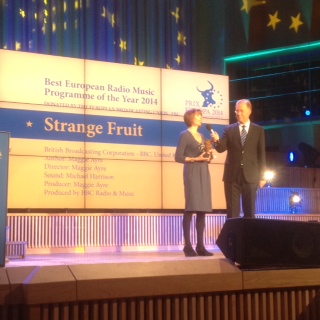
BBC Radio Producer Maggie Ayre received Prix Europa 2014 in Award in Berlin for Best European Radio Music Programme for ‘Strange Fruit.’
Congratulations to Maggie Ayre, BBC radio producer, for winning the prestigious Prix Europa Award 2014 for Best European Radio Music Program “Strange Fruit,” that featured my storytelling about lynching among others. The award was presented in Berlin on October 24, 2014. Click here for a link to the Prix Europa winners and award-winning ‘Strange Fruit’ program. The award ceremony will be streamed on the website through November 8.
“The song, Strange Fruit. memorably encapsulates a poetic depiction of the brutal lynchings in the southern United States. The winning programme used this Billie Holliday song to explore the deep wounds, encountering people with close connections to the events; the stories were calmly recounted, adding intensity to the words, and allowed time for reflection. The song is delicately woven into a tapestry of sad memories. Strange Fruit demonstrates the ability of radio to communicate strong emotions and profound insights,” stated the Prix Europa Award 2014 announcement.
History: “PRIX EUROPA – The European Broadcasting Festival awards the best European Television, Radio and Online productions each year with the aim of publicising them throughout Europe and supporting their continental distribution and use. It calls on all media professionals and their commitment to quality to compete against each other with their best productions.”
My Indigenous and Native American ancestors are finally getting some respect. Columbus Day is getting re-branded. I know that my ancestors would be thrilled to see more American cities recognize the truth: That Columbus did not ‘discover’ America. Thankfully, some cities, like Seattle, are now giving the Columbus Day holiday a Native flavor.
“This year’s Columbus Day holiday will have a slightly different, more Native flavor in the city of Seattle. Thanks to a unanimous vote this summer by the city council, the federal holiday will now be known by a different name: Indigenous Peoples’ Day. The name change comes after activists pushed for a day to honor indigenous people instead of Christopher Columbus, the most recognizable figure linked to European contact with the Americas.” For the complete story, click here.
I hope one day New York City will see the light. There’s certainly plenty support in this town.
Many truths were heard loud and clear recently, at a rally in New York City near the landmark statue of Christopher Columbus at Columbus Circle. Native Americans, Indigenous groups, regular New Yorkers and tourists participated in a Pow Wow to focus attention on the “grand theft, genocide, racism, torture, and maiming of Indigenous people,” by Columbus and other American, Spanish, and British colonizers.
The New York gathering included: Ecuadoran community activists, Sharakapk Earth Keepers, Inwoodearthkeepers@gmail.com, Biblioteca Indigenamovil (mobileindigenouslibrary.webs.com) Chief Plenty Coups, Apsaalooke, Crow, Indigenous Outreach Project, Citizens Committee for New York City, Garifuna Coalition (www.garifunacoalition.org), Colectivo Popol VujItinerante, and more.
Would you swap Columbus Day for Indigenous Remembrance Day?
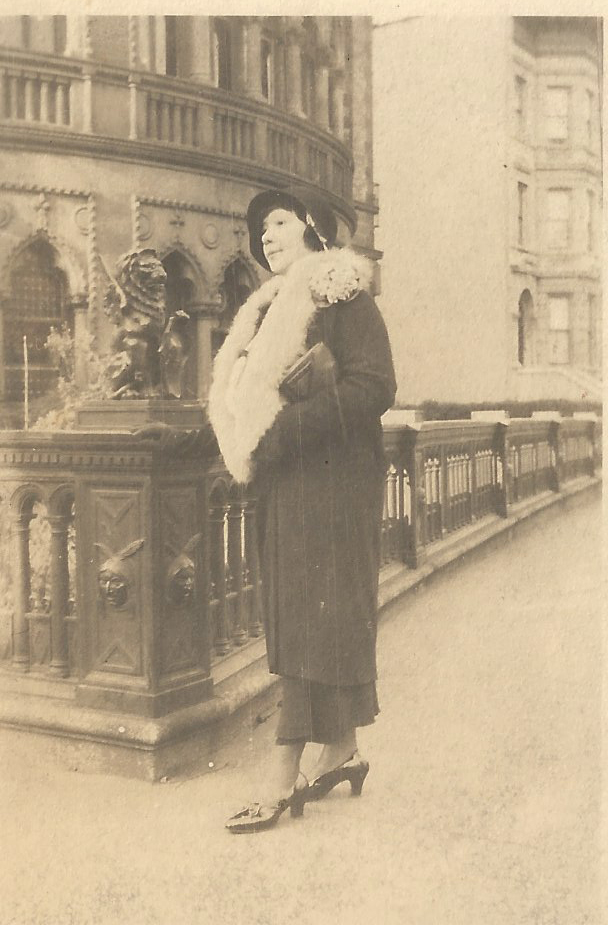
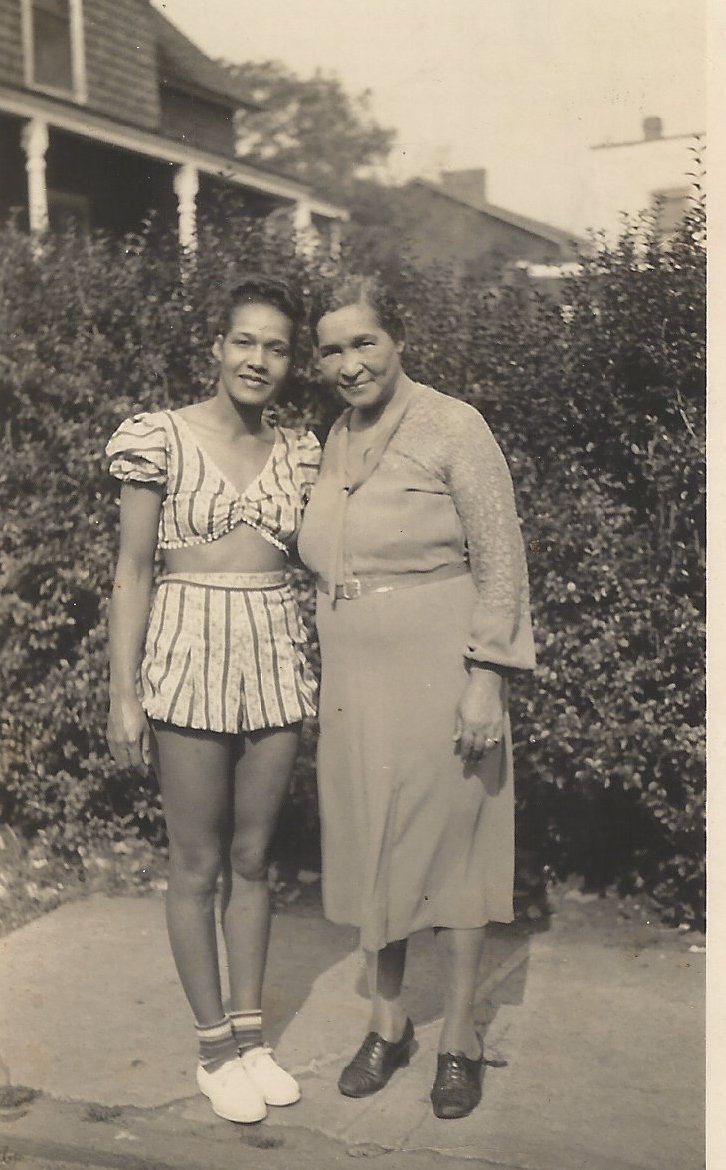
Posing in Harlem, my paternal Aunt Bertha Stuart Rice, who ‘passed’ as a white person, claimed our family as Creole.
Conducting oral history interviews takes patience and planning. Your family and community members hold precious stories and memories that are legacies of tradition, culture and history. But, what should you do if relatives are reluctant to be interviewed? As a genealogist, I do what I call the ‘un-interview.’
The first time I went to Mississippi and Louisiana to learn about my father’s Southern roots, I was warned: “Don’t come down here asking questions and digging in local court records alone. Southerners are very suspicious of Northerners,” said my Louisiana cousin Antoinette. “The Mississippi blacks and whites are even more clannish and they stick together,” she said. Besides being a musical and show business family, my paternal elders said that we were Creoles. I wanted first-hand knowledge. Once my elders left the South for Harlem, as part of the nation’s largest Black Migration, they never returned. But many of my relatives stayed. So, I needed to go there. One Southern elder cousin agreed to be interviewed. But she changed her mind when I arrived. “Not on camera. Maybe I will do audio,” said cousin Snow Owl as she eyed my equipment. I slowed down. We needed to spend time together simply visiting, cooking, shopping, talking, eating and going to church to meet-up with her friends, neighbors and extended family.
Check out these guidelines from the Smithsonian Center for Folklife and Cultural Heritage: “When interviewing members of your family or local community, be sure to seek out not only what they can tell you about the past, but what they can tell you about life in the present. How have certain family traditions evolved? What holiday customs are practiced today that weren’t a generation ago? What special foodways and rituals are part of community celebrations and why? What skills and abilities are needed to practice a particular craft or trade? How are these skills learned, mastered, and passed on to younger generations?”
Here are my top 5 Oral History tips
1.Build trust. Do your genealogy homework to check names, dates and facts. Learn multicultural dialogue rules and community rituals. Seek permission before all interviews. In my mixed-race family you must share a cup of tea, visit for three days, or bring gifts before you can ask anything. Asking questions is considered rude in some cultures. Timing is everything. Slow down. Wait for the right moment to bring up sensitive topics like slavery. Group gatherings hosted by a trusted local family member or friend provides a great way to start. Tap your network to make connections to help you find ways to build trust.
2. Show and tell your project. I was producing a family documentary and a ‘cooking genes’ cookbook. I brought along video clips, old photos, Baptism certificates, census reports, DNA results, and recipes. These items opened doors. Once they realized that I was not seeking hard facts or figures but simply stories, they relaxed. Reluctance relatives and family friends now loved being the center of attention and telling their stories. They were able to clarify and correct official records and add recipes.
3. Equipment. Less is best. Bring a mobile device, camera, and a portable scanner. Explain your interview process so the subjects know what to expect.
Creole family: Aunt Katherine Brigman and paternal grandmother, Madame Tempy Stuart Smith
4. The Un-Interview. Don’t ask Yes or No questions. Don’t interview or use the word ‘interview.’ As a long-term genealogist, I learned that people hate interviews! My people equate the word ‘interview’ with ‘interrogation.’ Engage.Do ask for stories. Here are sample questions that generated conversations and details: Describe memorable weddings or funerals. Describe our family’s religious and spiritual practices. What languages or Creole words do you remember? How has this neighborhood changed over the years? What are the secret ingredients in this delicious Gumbo or Creole dinner? What are you growing in your garden? Describe routes and regional ways of transportation. Who are your favorite musicians? What dance steps do you remember? Who/What are your favorite writers, books, songs, artists, and films? Don’t judge the answers. Put the subjects at ease and tell them that all their words are precious. Ask a question and listen. Do not interrupt or correct.
5. Wrap-up: Share interview results with photos, video, and transcriptions.
What are your top oral history tips?
Veterans share oral history and tell personal stories in New Orleans at National WWll Museum, @WWllmuseum, where oral histories are featured.