Narrative Network wins AVA Digital Gold Award from among 2000 global entrants
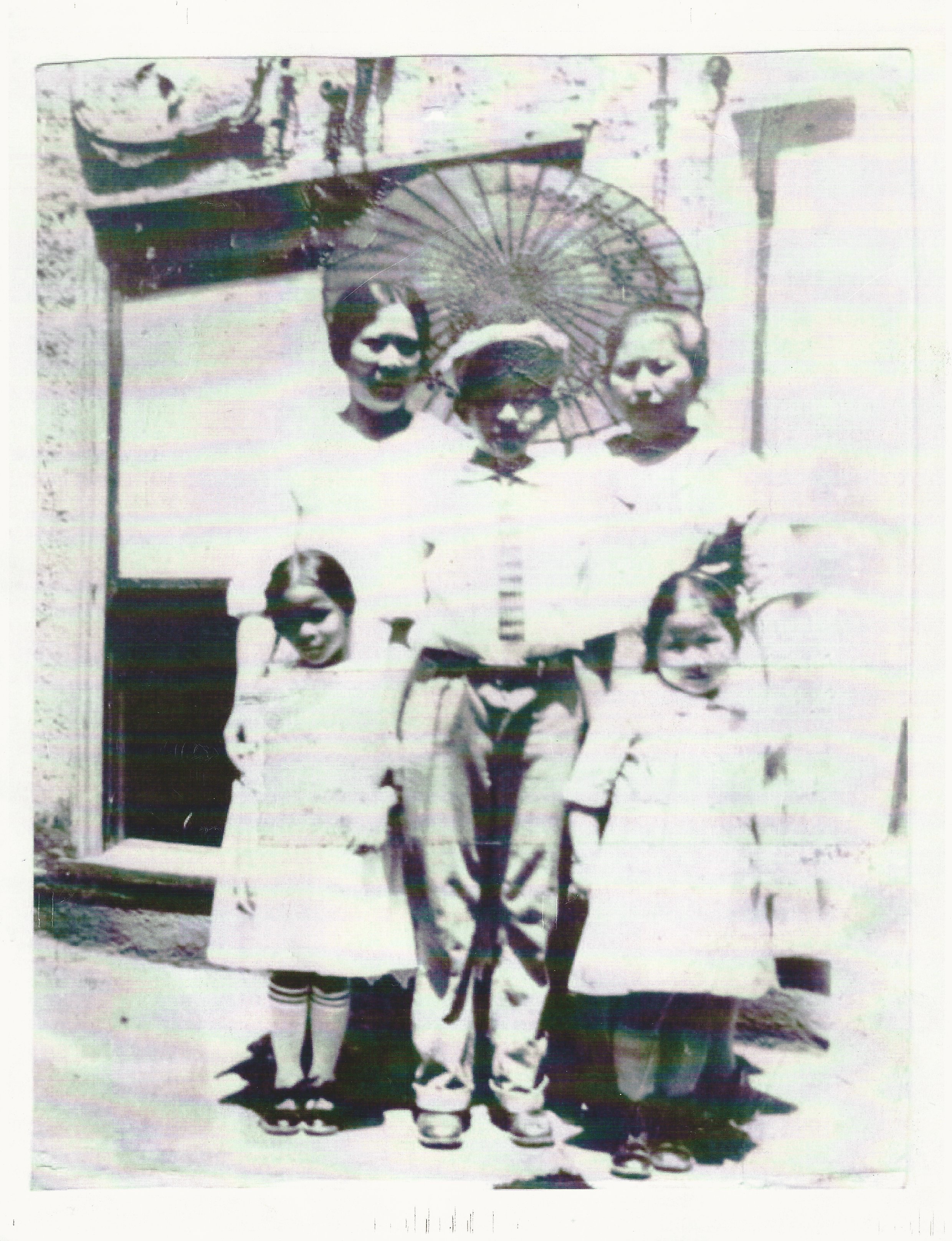
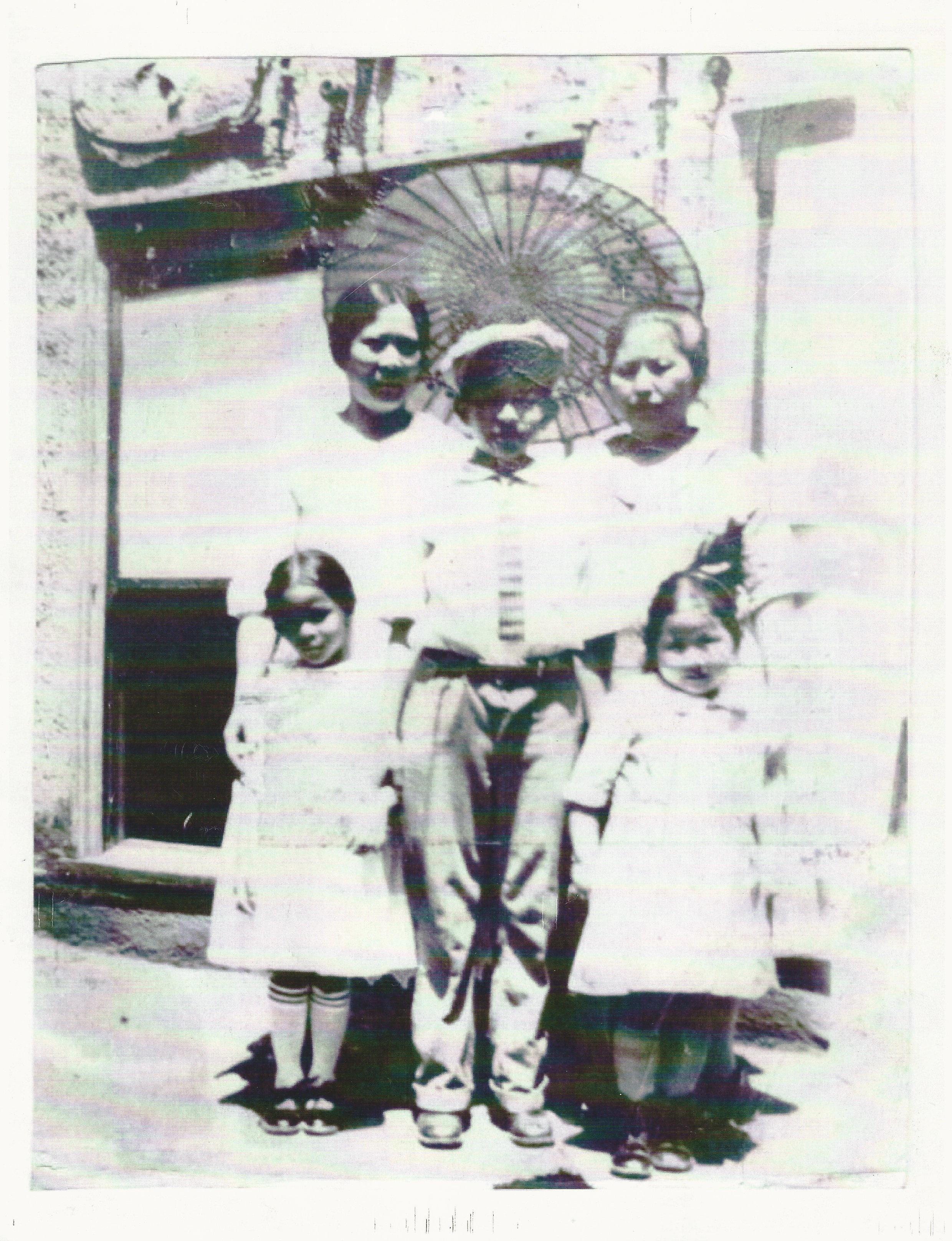
My Hakka Chinese family from Caribbean pose in Los Angeles on way back to Harlem.
New York, NY (February 1, 2013) Narrative Network and LS3 Studios are winners of the AVA Digital-Gold Awards, for co-producing documentary trailer “From Shanghai to Harlem,” in the category of Creativity Video Production/Editing, it was announced on February 1, 2013. AVA recognizes outstanding achievement by creative professionals involved in the concept, direction, design and production of media that is part of the evolution of digital communication. Work ranges from audio and video productions to websites and social media sites that present interactive components such as video, animation, blogs, and podcasts to other user-generated digital communication.
There were 2,000 entries from throughout the United States, Canada and several other countries in the 2013 competition. Entrants included digital professionals from audio, video and film production companies; web developers; advertising agencies; PR firms; corporate and government communication departments; and independent creative professionals such as designers, producers, directors, editors and shooters.
AVA Digital Awards is sponsored and judged by theAssociation of Marketing and Communication Professionals (AMCP). The international organization consists of several thousand production, marketing, communication, advertising, public relations, and free-lance professionals. AMCP administers recognition programs; provides judges and rewards outstanding achievement and service to the profession. As part of its mission, AMCP fosters and supports the efforts of creative professionals who contribute their unique talents to public service and charitable organizations.
Judges are industry professionals who look for companies and individuals whose talent exceeds a high standard of excellence and whose work serves as a benchmark for the industry.
Winners, who will receive certificates and inscribed statuettes, were selected from over 200 categories in Audio, Video, and Web-based production. A list of Platinum and Gold Winners can be found on the AVA Digital Awards website at www.avaawards.com
In honor of my Chinese ancestors, Gong Xi Fai Cai!, from my family to yours. Wishing you a prosperous Year of the Water Snake!
My Chinese ancestors come from Trinidad and Guyana. Many people ask me: “How did the Chinese land in the West Indies?” The short answer is: Slavery. But the full answer is more complicated than that. The Chinese in the Caribbean had to do with indentured workers, migration and immigration. Then their story gets more complicated!
Here is an excerpt from Indentured Labor, Caribbean Sugar-Chinese and Indian Migrants to the British West Indies, 1838-1918, by Walton Look Lai, page 87-88.
“Life and Labor on the Plantations: The Chinese”: When the Cantonese region began to show increased emigration activity in the years following the first so-called Opium Wars (1839-42), Western importers began to pay active attention to the prospect of recruiting cheap labor from this source. A British parliamentary committee had tried to revive the issue of Chinese immigration to the West Indies as early as 1811, but there was no follow-up. In 1843, licenses for the importation of 2,850 Chinese were actually granted (six for British Guiana and 2,150 immigrants, one for Trinidad for 300, and one for Jamaica for 400). But the projects were never undertaken because at this point the importers were expected to bear the financial risks themselves, and their agents in the East could not get many Chinese to migrate to the West Indies voluntary.”
But eventually, many Chinese indentured workers did arrive in the Caribbean islands to replace the formerly enslaved Africans and native Caribbeans. According to many oral history documents recently translated, many of those early Chinese migrant workers were given false papers, some were forced onto ships and treated as bad or worst than the African slaves. My family stories are still being discovered through genealogy and research. The search continues. Stay tuned!
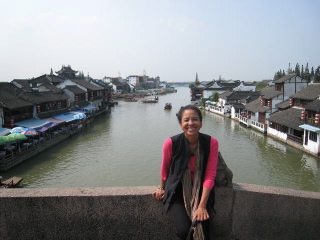
Sylvia Wong Smith Lewis in canal village in Shanghai, China.
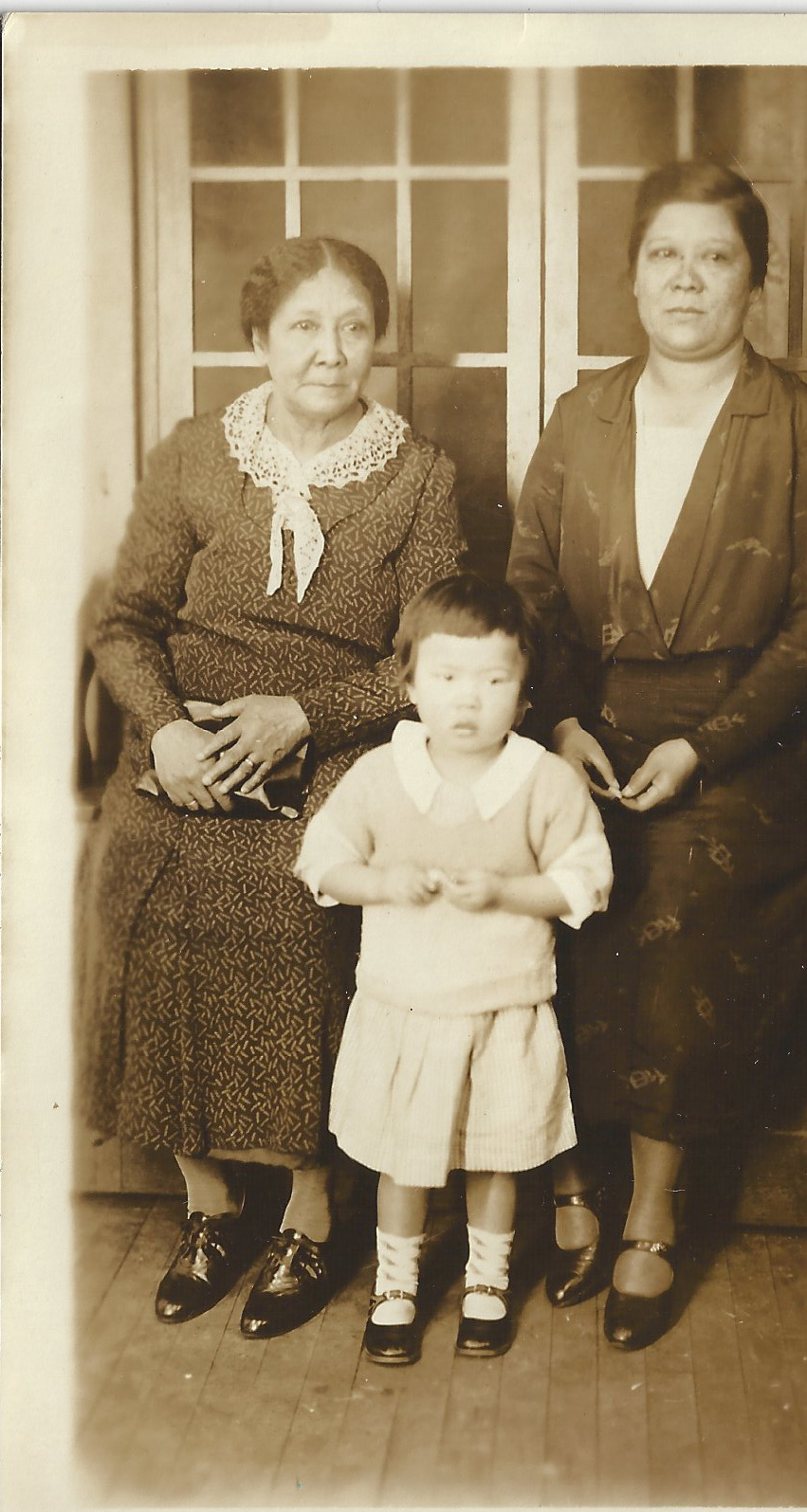
Paulina Joy (maternal great grandmother); Emily Looney, maternal grand aunt (grandmother Violet’s sister); Pauline Chan Keong (my mother’s baby sister). Photo taken in China on way back to Los Angeles.
My mother Carmen, grandmother Violet, Uncle Owen, grand Aunt Emily, Sakaye, Japanese ‘cousin’ who was adopted by my family while her family was sent to internment camp. Photo taken in Los Angeles, CA.
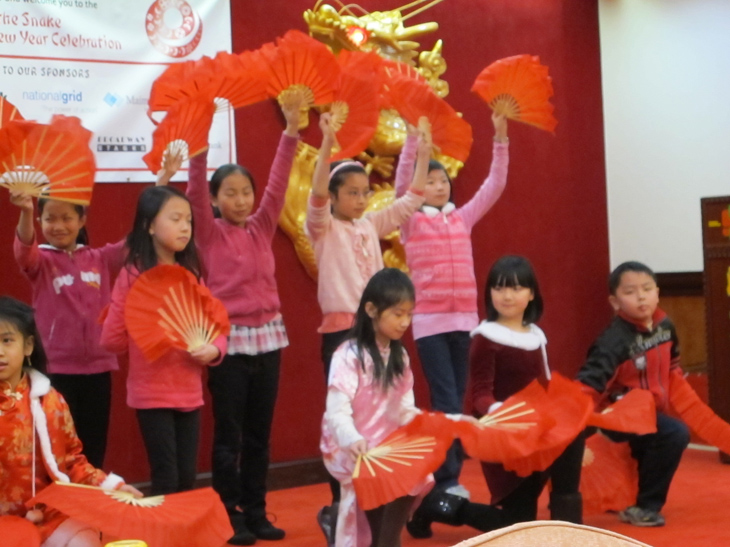
Children dancing at Chinese New Year’s banquet hosted by Marty Markowitz, Brooklyn Borough President.
I celebrated Chinese New Years in Brooklyn again this year. Hosted by Brooklyn Borough President Marty Markowitz, over 400 turned out for his annual Chinese New Year Banquet to benefit the Camp Brooklyn Fund. This year it was held at the New Spring Garden, an A-rated restaurant in Sunset Park on February 7.
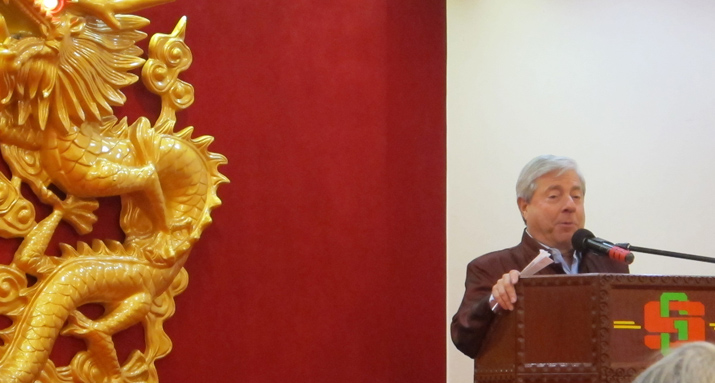
Marty Markowitz, Brooklyn Borough President opens Chinese New Year’s program.
Brooklyn’s Chinatown, located in the Sunset Park section, is the fastest growing Chinese community in the country, already surpassing Flushing, according to US Census reports. Marty Markowitz gave a rousing New Year’s greeting and saluted the achievements of this Chinese community for creating one of NYC’s best school districts and successful business districts. He also gave a special greeting and congratulations to Brooklyn Chamber of Commerce’s new Chair,Denise Arbesu, whose husband recently rolled off as outgoing Chairman. There were many officials, dignitaries, business leaders and sponsors in the room.
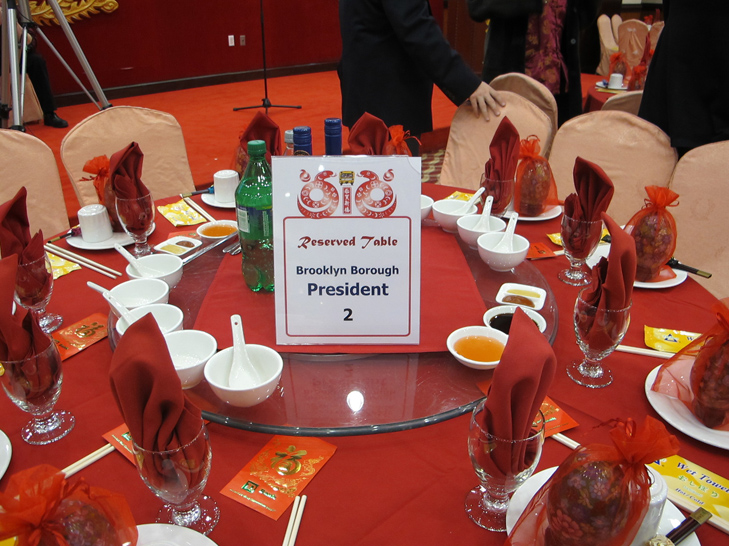
Brooklyn Chinese New Year’s banquet table setting at New Spring Garden.
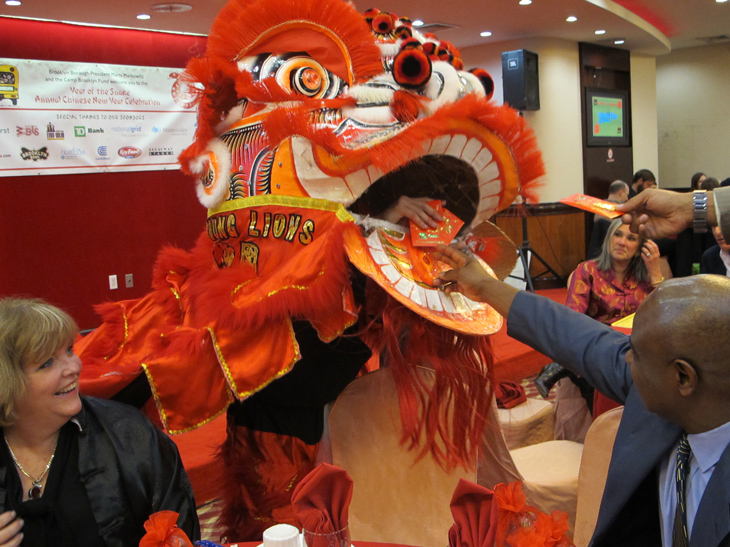
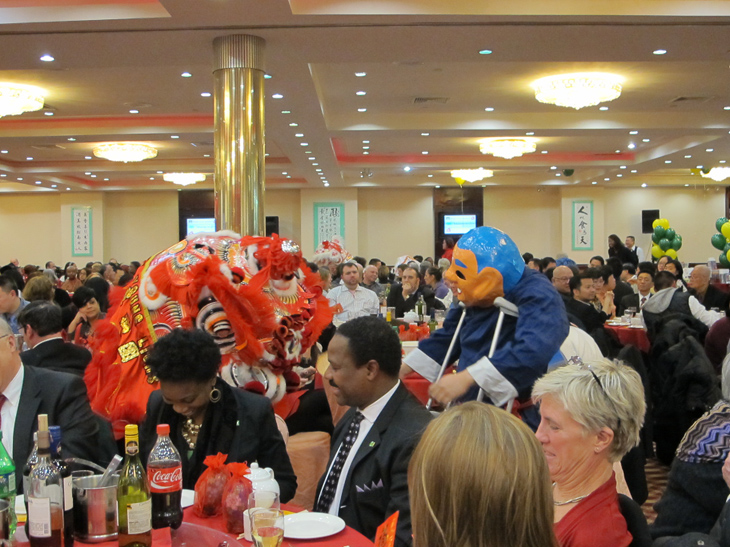
The program opened with children performing wonderful dances. The traditional dragon and its masked sidekick made its way around the huge dining room to drum beats and tambourines. Patrons excitedly “fed” the dragon’s mouth with red envelopes containing money for the Camp Brooklyn Fund.
Feeding the dragon at Chinese New Year’s banquet in Brooklyn’s Chinatown.
This was definitely an event that I should have worn my stretchy pants. We ate so much that I forgot to take photos of the food. But here’s the Menu: Appetizers: Steamed Shrimp Dumplings, Traditional Pork Dumplings; and Crispy Vegetable Spring Rolls. Soup: Marty’s favorite Velvet Chicken corn Soup with Homemade Fried Noodle. Entrees: Jumbo Shrimp with Honey, Walnuts and Sauce; Special New Year’s Grouper with Vegetables; Sizzling Beef over Bok Choy; Sweet and sour Spare ribs; New Spring Garden Sesame Chicken; Crowd Favorite Vegetable Fried Rice; Chicken Chow Fun Marty-Style; Sautéed String Beans in Garlic Sauce. Desserts: Fresh Sliced Oranges; Chinese Fortune Cookies. Beverages included White and Red wines and Tsingtao Beer.
The honorees were: Kenneth D. Daly, President of National Grid; Deon Livingston, Vice President & General Manager of WBLS & WLIB-FM; Michael “Buzzy” O’Keefe, Restaurateur Extraordinaire; and Yvonne Riley-Tepie, Vice President, US Field Marketing, TD Bank.
This year, we celebrate the Year of the Water Snake. Unlike Western culture, the snake symbolizes positive attributes in Chinese culture. The Snake is the intuitive, introspective, refined, cool and collected animal in the Chinese horoscope. They are attractive people who are graceful, exciting and dark all at the same time. They can become quite possessive when they set their minds on achieving the interest of a partner, according to some Chinese horoscope guides.
This is your year if you were born in: 1917, 1929, 1941, 1953, 1965, 1977, 1989, 2001, and 2013. Some famous Snake people include: Oprah Winfrey, John F. Kennedy, Abraham Lincoln, Martin Luther King, Jr., Pablo Picasso, Bob Dylan, James Joyce, Martha Stewart, Kanye West, Pierce Brosnan, Charlie Sheen, Courtney Love, Howard Stern, and Edgar Allan Poe, according to LA Examiner.
Dragon and masked sidekick winds their way around 400 diners at Brooklyn Chinese New Year’s banquet.
Celebration: If you feel like braving the cold weather, come out to celebrate Chinese New Years in Brooklyn’s Chinatown on Sunday, February 10. As usual, the Brooklyn Chinese American Association (BCA), a community service organization founded in 1987, organized this year’s festivities.
Schedule: 10 am-Noon performances by and for children, speeches, followed by firecrackers. Noon-1pm Parade from 50th to 60th streets. Visitors should go to 50th street and 8th avenue in Sunset Park area.
Directions: Take MTA, D train to 50th street, walk up hill four long blocks to 8th avenue. Make a day of it or go anytime. After the parade, explore the local area for New York’s best Chinese food and terrific local shopping.
Gong Xi Fai Cai, from my family to yours. Wishing you a prosperous Year of the Water Snake!
My father’s Creole New Orleans and mother’s Caribbean food ways were based on rice and beans. Here are two of my favorite rice and beans recipes. Both styles have roots in Spanish, French and African traditions.
Creole-Cajun style red beans and rice with andouille sausage.
Only on Mondays: Louisiana Creole red beans and rice was a Monday tradition in our New York home. Ham, bacon and andouille sausage were major ingredients. Only recently did I learned why we ate these beans on Mondays. Turns out, it was all about multitasking. Apparently, Mondays was traditionally laundry day in many Southern homes. My father’s southern relatives taught my mother to keep up this food tradition. For the record, mother did laundry everyday because she ran a home-based daycare center. But, that’s another story. Beans ‘cooked down’ with Sunday’s leftover ham bone does not require much fuss. Thus, you can wash, iron, fold laundry and cook all at the same time! But the secret to this delicious dish is to get started right after Monday’s breakfast so that the flavors have enough time to deepen in time for dinner. And these beans become tastier as each day passes. Another flavor consideration is how to bake the ham the night before. Did you baste it with a mixture of brown sugar, mustard, pineapple slices and clove? I would. I use whatever is on hand. Substitute ham bone with a ham hock. I only eat brown rice. This dish is traditionally served with white rice. Sometimes we ate these beans in a bowl with a side of cornbread!
Creole Red Beans and Rice
Ingredients: kidney beans 1 lb., 1 Sunday leftover ham bone or 1 medium smoked ham hock; 1 andouille sausage or 4 slices bacon; 1 tbsp. vegetable oil; trinity—1 chopped medium onion, 3 celery stalks, chopped w/leaves, 1 medium chopped bell pepper; 4 chopped cloves of garlic, 4 whole cloves, 2 Bay leaves, 1 tsp. each parsley, sage, thyme or 4 sprigs of each fresh herb; hot sauce to taste; black pepper to taste, ¼ tsp. cayenne pepper; 1 quart water; reserved bean water; 6 cups cooked brown rice.
Directions: wash, sort, and soak beans overnight in 1 quart of water. Reserve the maroon-colored bean water.
In deep heavy skillet or Dutch oven, sauté on medium heat, sausage or bacon slices, trinity, garlic in vegetable oil until translucent. Render fat, oil. Add water, press cloves into meat on hambone or hock; add the drained, soaked beans, herbs, and seasonings. Bring all to boil, half-cover with lid, simmer 4-5 hours. Add bean water sparingly throughout cooking; stir and mash some of the beans to create a thickened, creamy bean broth. Serve over cooked rice.
Note: To shorten the cooking time to 30 minutes, use canned beans, add ‘Cajun’ seasoning to water stock. Keep rest of ingredients.
Caribbean Red Beans and Rice
Although Trinidadian, my mother served Jamaican ‘peas and rice’ often. It is not really ‘peas’ but kidney beans. We ate this sometimes everyday with stir-fried veggies, meats or fish. It is a mild, vegetarian, gluten-free one-pot rice dish that pairs well with all Caribbean and Creole foods.
Caribbean beans and rice.
Ingredients: red beans, 1 lb. cooked; 1 can (13.5oz.) of coconut milk-Goya, Coco Lopez brand, Indian or Thai variety is good; 2 ¼ cups maroon-colored bean water; 2 cups rice; ¼ cup fresh grated coconut (optional) (Do not use bagged grated coconut from bakery aisle!), 1 tsp. vegetable or coconut oil, ½ cup chopped medium onion, 1 chopped scallion, 2 sprigs thyme, 1 whole Scotch Bonnet hot pepper. Do not cut or chop Scotch bonnet pepper. Just leave in pot!
Note: Cooking the beans together with rice in the same pot is an art form. Too much liquid makes mush. Not enough liquid with rice makes a dried out mess. Remember, the beans must be cooked, as above, or use canned beans. I found Basmati or Uncle Ben’s rice is the easiest to cook. Basmati brown rice works very well. Use 1 cup of rice to 2 cups of liquid. Remember that brown rice requires at least ½ cup extra liquid and extra time cooking. You can substitute with pigeon peas, black beans, and black-eye peas.
Directions: Heat oil on medium heat, sauté scallion, onion, garlic, thyme. Add rice, beans, coconut, and liquid. Bring to boil uncovered. Stir in Scotch bonnet pepper, cover and simmer, about 30 minutes or until done.
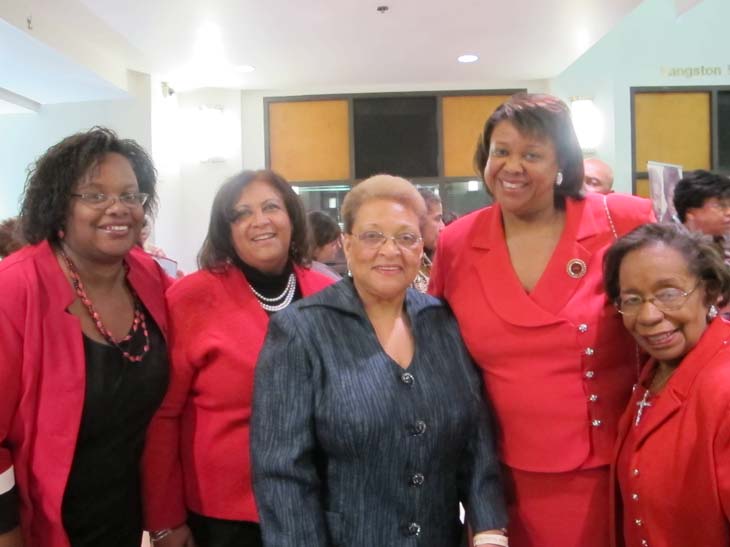
Ruby’s Delta sisters: (L-R) Rosia Blackwell-Lawrence, Margaret Bing-Wade, Mary Redd, Cynthia M.A. Butler- McIntyre, Dr. Marcella Maxwell
Do you have a Ruby Dee story? Ruby’s Delta sorority sisters shared their love at her 90th birthday party:“It was such an honor to witness and be a part of such a befitting artistic display of Ruby Dee’s life and career, as captured on the big screen and documented by her grandson, Mr. Muta’ Ali,” said Cynthia Butler-McIntyre, National President of Delta Sigma Theta Sorority, Inc. There is no doubt that Ruby Dee’s countless television, Broadway stage, and film roles are entwined with over half a century of the entertainment industry’s history,” said Butler-McIntyre. “But, what has kept Ruby Dee near and dear to our hearts and why we (Delta Sigma Theta) saw it necessary for Soror Ruby Dee to grace us with her elegance, wisdom, tenacity, and audacity as a member, is the mere fact that she and Mr. Ossie Davis believed that ‘any form of art is a form of power.’ ”
“Soror Dee was instrumental in helping Delta Sigma Theta realize its dream of controlling the images of African-Americans and how we were portrayed on film. She assisted us in producing and played a leading role in ‘Countdown to Kusini’ – a Black film, which was filmed in Nigeria,” said Butler-McIntyre.
“Ruby Dee is a shining example of how one’s artistic talents and abilities can be used to dispel stereotypes and fight against racial injustice,” said Rosia Blackwell Lawrence, New York Metro State Coordinator.
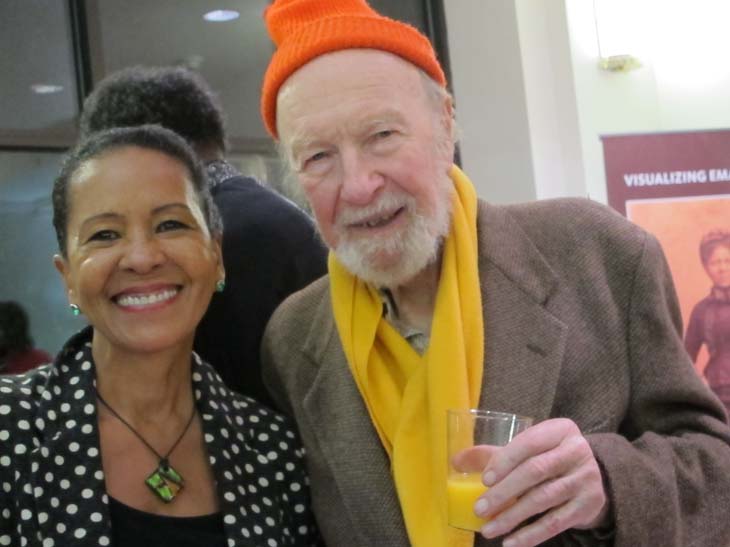
Sylvia Wong Lewis with Pete Seeger, iconic folk singer at Ruby Dee’s party.
Actor Rosie O’Donnell said that she worked with Ruby on a film about foster care recently. “Working with Ruby was tremendous!” Folk singer Pete Seeger said that he could not remember all the things that he did with Ossie Davis and Ruby Dee over the past 70 years but that it was “fun and about art and activism.”
Personally, I remember when Ruby Dee came to my high school, George W. Wingate in Brooklyn, in 1970 to talk to Black students who had been accepted to college. Ruby was brought there by a forceful Black guidance counselor named Mrs. Mc Caddy, who had organized the gathering. She said that her famous movie star friend Ruby Dee was coming to give us a pep talk. We were so excited. Ruby spoke about her college days and reminded us about the Civil Rights movement. She said that her husband Ossie and many in her generation fought for us to have access to education. She reminded us that it was our obligation to reach back to mentor those coming behind us.
Sylvia Wong Lewis with Rosie O’Donnell at Ruby Dee’s party.
A Harlem dance school owner shared a story. She said that Ruby registered her own daughters in the school to help drum up business for the fledgling dance school. “Ruby was so supportive to me and I was a complete stranger to her. Ruby and Ossie were like that. If they heard that you were doing something positive, they were there for you. We used to be a ‘real community’ back then.’ Everyone in Harlem signed up just because Ruby’s kids were my students!” the Harlem resident said, who didn’t want to give her name.
The point about being a complete ‘stranger’ is important and why Ruby and Ossie are so beloved. To Ossie and Ruby, there were no strangers, they were always approachable. They are probably the last of their kind, with a few exceptions. Ossie and Ruby would indeed show up for your gathering or any community event. We could always count on them to narrate a documentary or MC a benefit for free if they felt that it was a good cause. Today’s ‘stars’ are not as approachable. Happily, the stars were aligned and many said said yes! when asked to come out for Ruby’s birthday!
Champagne toast for Ruby Dee’s 90th
Dressed in hot pink, Ruby Dee celebrated her 90th birthday in grand style. It was a film tribute to her life at Harlem’s Schomburg Center for Research in Black Culture on November 14, 2012. Ironically, it was in the Schomburg’s basement theater where it all began. Ruby met husband-to-be Ossie Davis and co-stars Harry Belafonte, Sidney Poitier there and the rest, as they say, was history.
Now, nearly 70 years later, family and contemporaries like Pete Seeger, 93; Harry Belafonte, 85; and David Dinkins, 85, flanked the grande dame of stage, screen and picket lines. She was feted with film clips from a documentary-in-the-works entitled Life’s Essentials with Ruby Dee, directed by one of her seven grandchildren, Muta’Ali Muhammad.
Testimonials also came from the First Couple, President Barack Obama and First Lady Michele Obama in the form of a proclamation. Video greetings from Alan Alda, Glynn Turnman, Jeffrey Wright and others highlighted the evening.
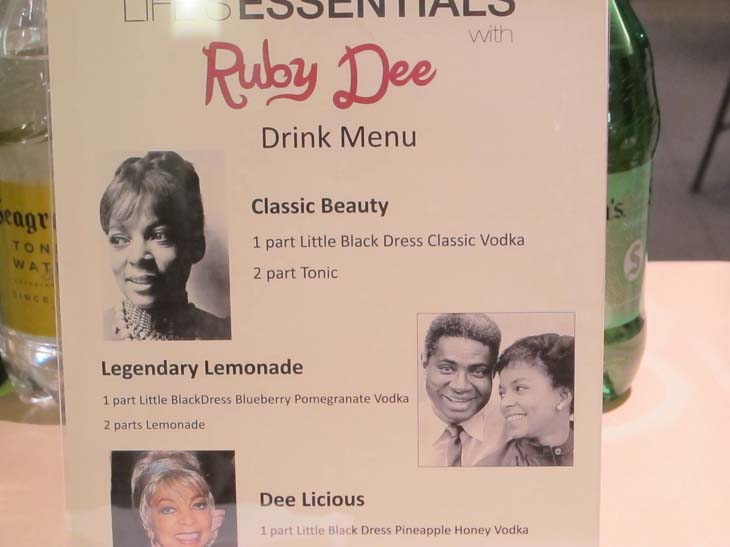
Ruby Dee’s party bar card.
For a certain generation though, Ruby Dee and Ossie Davis were America’s first favorite couple. Their lives seamlessly intersected politics, the arts, media and activism. The auspicious occasion was hosted by two other famous couples— actors Angela Bassett with husband Courtney Vance and Susan L. Taylor (Essence Magazine) and author-husband Khephra Burns, who performed an original poem together.
Some of the other luminaries in attendance were Jesse Jackson, Rosie O’Donnell, Danny Glover, Charles S. Dutton, Melvin Van Peebles, Rev. James A. Forbes, Micki Grant, Malik Yoba, Woodie King, Barbara Montgomery, Khalil Gibran Muhammad, among others. The party music featured Stevie Wonder’sMy Cherie Amor and Happy Birthday withdelicious food catered by Norma Darden’s Spoonbread.
Life’s Essentials with Ruby Dee reached lovingly deep into the family’s archives. One scene took place inside their huge storage barn packed to the rafters with awards, plaques, playbills, poster, costumes, and stage props. Witnessing that scene along with rare film footage portrayed a glimpse of lives well lived. But most of all, we were all grateful for the memories, especially to see the late Ossie Davis, again, who died in 2005.
Funny and sad reflections from the children and grandchildren gave the viewer a hint of what it was like to live inside this amazing family. Working with producer Jevon NJ Frank, it took Muta’Ali 300 people over 40 days to raise $50,000 on Kickstarter to pay for the 30-minute excerpt. The final film is expected in 2013.
After a champagne toast, Ruby Dee said: “I am totally surprised and overwhelmed. It would be too easy for me to cry. Let’s remember that we are all miracles. Time to get busy!”
The screening was made possible by sponsors Delta Sigma Theta Sorority Incorporated, Camille and Bill Cosby, Carol Sutton Lewis and William M. Lewis, Jr. Charitable Foundation, AARP, Billye and Hank Aaron, and 1199 SEIU.