Slavery Group

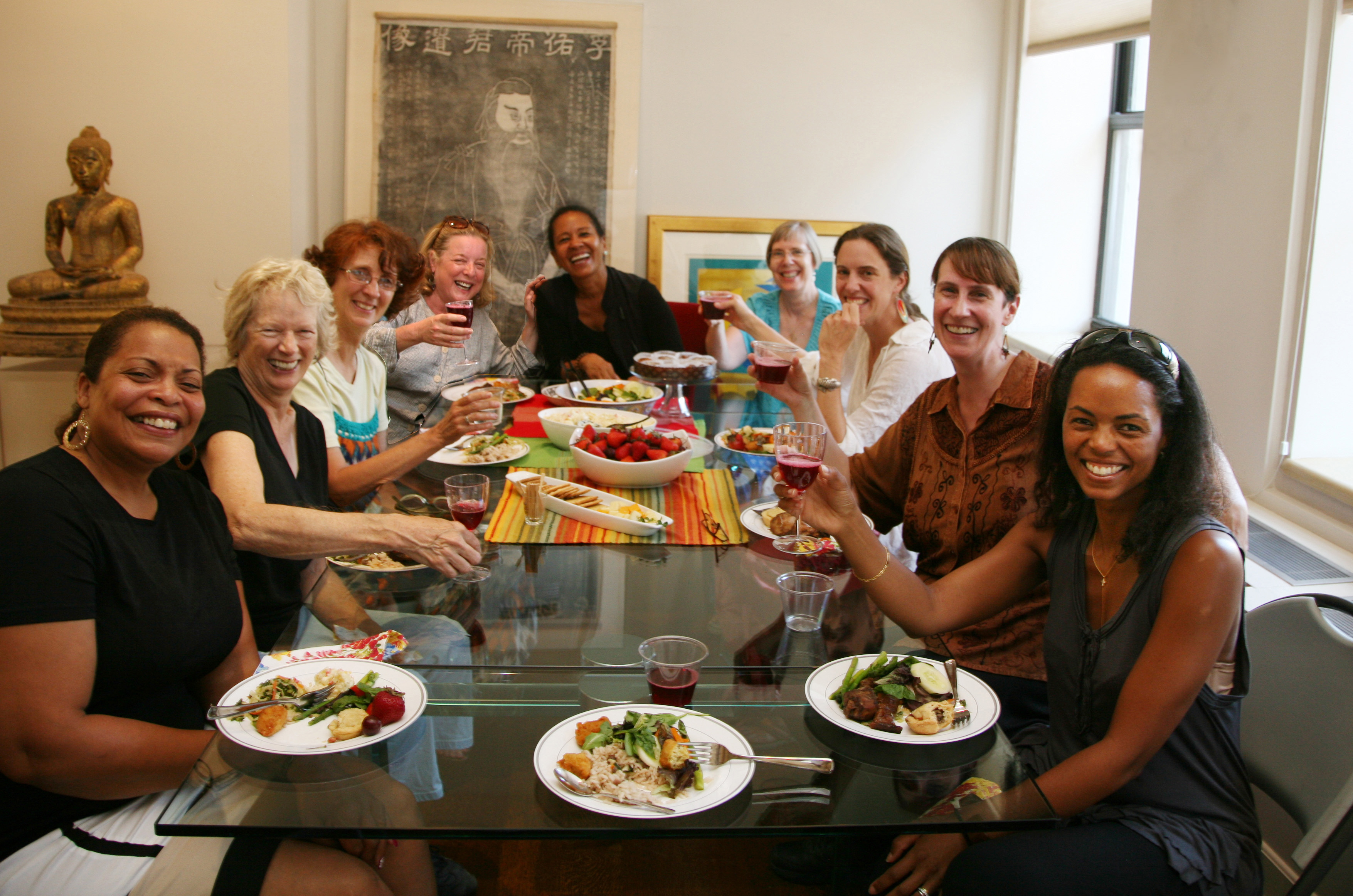
Members enjoy soul-Caribbean brunch at Sylvia Lewis’ home meeting of Coming to the Table, NE Chapter.

A slavery group? Yes. I’m an activist about slavery education. “What happens in your slavery group?” I have been asked this question before.  On July 22, ten members from Coming to the Table (CTTT), Northeast Chapter gathered at my home to break bread together and share stories with one another.

This was the third ‘local’ meeting of  ‘my slavery group,’ the Northeastern CTTT, who are from New York City/NJ area, Boston and New Haven area. We are a joyful and loving group in support of healing and reconciliation. Our meetings are facilitated by two co-facilitators—one White and one Black. We eat first, then sit in a circle and take turns talking and listening to each other. We take a few breaks until the end.

As our mission states: The transformational nature of the CTTT approach requires that we meet face to face so that we can build authentic relationships, strong enough to withstand the challenges of honestly facing our past, present and future together.

Since we are mostly a ‘virtual’ group, the local meetings are a very special opportunity for bonding. We welcome new members.

I had already posted on this blog about attending the National meeting, ‘Monastery Weekend’ in April, 2012.  It was lovely experience for me. But it was expensive traveling to Richmond and logistically too demanding to provide enough opportunities for “in the flesh” connection and healing.

I can say honestly, we don’t wallow in guilt or anger about the facts of the American slavery system and  the Transatlantic slavery trade. On several occasions, I heard sincere public apologies for slavery.

Some in our group have spent decades researching their families. Others are descendants of notable slaveholders like Thomas Jefferson. A few people in our group stumbled upon the ‘slaves in their closet’ by looking at wills and deeds in family documents. That’s actually the typical way the Whites in this group found out about slavery in their family. Slave owners were not all rich people and everyone had slaves, it seems. Slavery was big business in the North, especially New York, New England especially Rhode Island.

In our group, we call ourselves ‘cousins.’ Our Face Book group topics are mostly amazing, educational, inspirational and enjoyable. Hanging out with this group has given me a whole new spin on American History. Our member’s personal stories fill in the blanks of our American narrative. Since joining this group I have found thousands of missing chapters from a book called ‘American History” that I thought I read already.

Our personal notes to each other are always supportive and signed with love and affection. We acknowledge that we are all connected in a human, spiritual, God-sense. Maybe, we really are cousins too.

Some of us are wrestling with ‘if’ or ‘when’ to contact our ‘linked descendant’—that’s a relative we found through genealogy who is linked through slavery. What if I got that call? I wonder what would I do? “Hello, My family owned your family…”

Black and White people have mixed feelings about slavery. In my family, they hate it. They never talk about slavery except in hushed tones. But, we are ‘race’ people—meaning that we discussed race all the time, everyday. This is true for most of my friends in my generation.

I became involved with Coming to the Table after learning details about my paternal African American great uncle, who was lynched in Ocean Springs, Mississippi in 1902. I actually was told about the lynching when I was very young. But I had forgotten about it because I heard not details. One I learned the details, I became traumatized. My healing journey began with a new friend who discovered her family member had lynched several Black people. Together we are on a mission, learning to sort through our feelings about our families and the atrocities that happened during slavery.

My mother’s Chinese ancestors were indentured servants who were ‘Shanghai-ed’  or taken from China and brought to South America and Caribbean. I am learning more about their history.

I found several White relatives who are 4th, 5th and 6th cousins through a DNA test. several reached out to me. Most of them were just as curious as I was. Only a few times did my White relatives ‘disconnected’ from me after learning my ethnic background.

So, in my slavery group, we talk about the manifestations of slavery in today’s society. We also look at models for storytelling from Third Reich discussions groups, Native Americans, South African and Rwanda reconciliation models. The first time I heard a White privilege discussion was at a CTTT event. It’s great to be able to talk about a wide range of racial issues and slavery-related topics in a safe place.
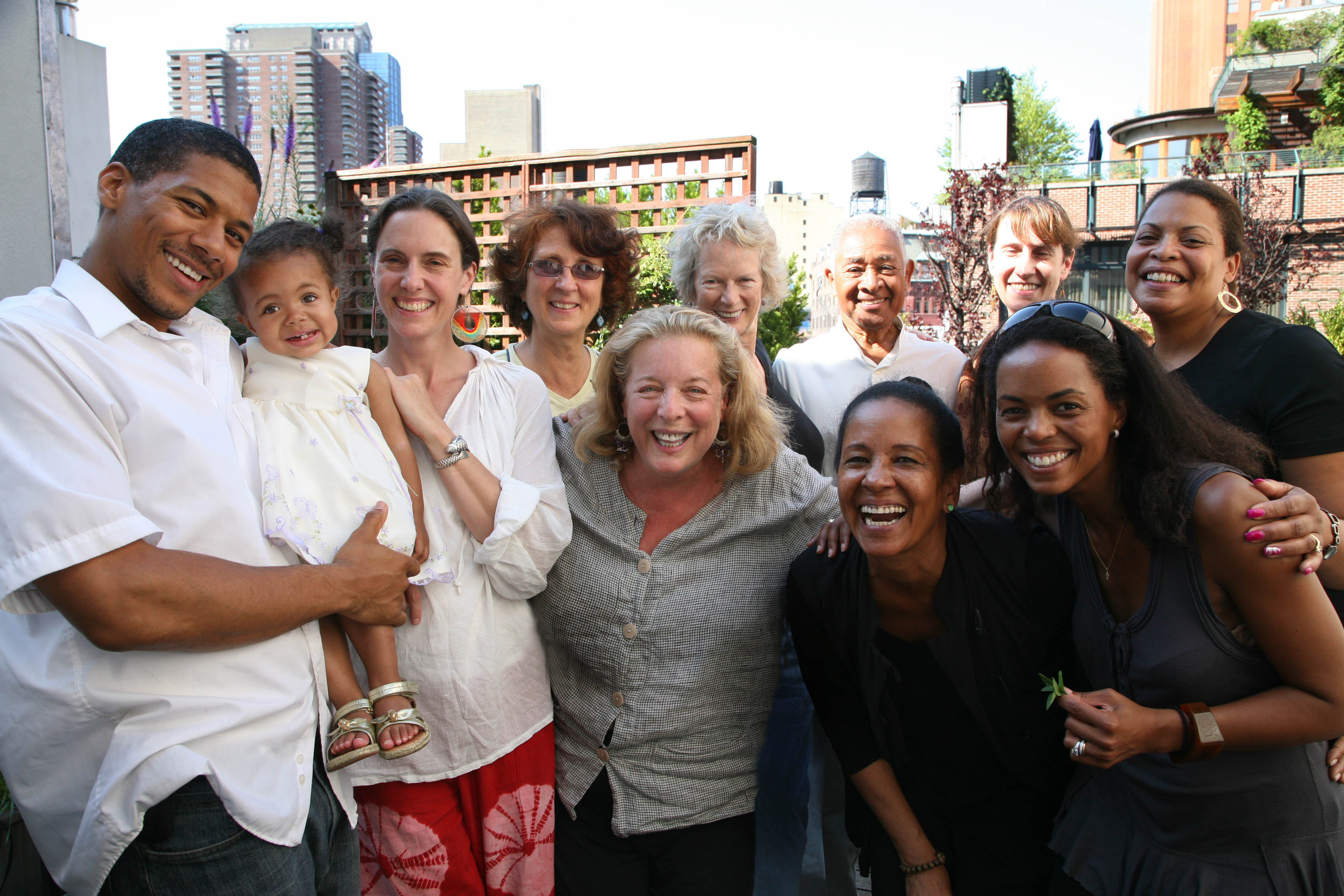
Slavery discussion group, Coming to the Table, gathered on Sylvia’s roof garden after chapter meeting ended.

We focus on accountability and reconciliation. Much of our work is difficult.  We are encouraged to bring a momento that can help us in opening our dialogue. Sometimes tears flow. In the end, we feel happy and close to each other.  I love the spirit, camaraderie and commitment of our group.

It is not all sad. Our gatherings are like group therapy. The fun part is the food where we literally ‘come to the table.’ I also enjoy sharing some my Afro-Asian-Indo-Caribbean-Soul-Creole food traditions. Yes, I will post more on food traditions soon!

It’s a blessing really that CTTT provides us a simple yet unique way to be more authentic than we dare be. We actually DO gather ‘at the table’ in our local meetings. Very few people sit down to talk and listen to each other like we do. So, I do believe that we are lighting the light for healing our nation.

Jimmy Breslin Honored at LIU

Jimmy Breslin, third from left, is flanked by LIU officials after he was presented an Honorary Doctorate degree.

I had the opportunity to meet the legendary newspaper columnist Jimmy Breslin last week, who received an honorary Doctorate degree from Long Island University (LIU), Brooklyn Campus. Actually, I had met Jimmy years ago socially a few times and then once when I was invited by the Daily News publisher to a meeting of community newspaper publishers. At the time I was publisher of the Caribbean American News. Along with a dozen or so Chinese, Russian, Spanish and outer borough community and ethnic newspaper publishers, we were going to be the subject of an editorial piece that Jimmy was to be involved. No, he did not remember. No, I did not remind him! Jimmy is a newspaper journalism rock star! When we small-time publishers left that meeting, we were all stunned that Jimmy was there. We exhaled a collective: “Wow!”

Because Mr. Breslin was unable to attend the LIU commencement ceremony held in May, LIU President David J. Steinberg decided to hold a special ceremony just for him in the campus Kumble Theater.

Legendary columnist Jimmy Breslin poses with admirer Sylvia Wong Lewis

The small ceremony was attended by his family including a daughter, his wife Ronnie Eldridge, former NY City Council leader and CUNY TV host, friends, University Trustees, Provost Gail Stevens and Faculty members. Although it was clear that he was moving a bit slower and may had been in pain, he did not let on. He joked to the empty seats in the audience about how he was “glad to be somewhere” and wanted a drink!

“It is right that we honor Jimmy for his talent, courage and achievement to tell stories about the common man. When the other reporters were writing about the rich and famous at President Kennedy’s funeral, Jimmy was the only one to focus on the grave diggers. He has come full circle since his students days in the 1950s when he left us after only two years. But his life’s work and achievement more than made up for it. He is an inspiration to students on what is possible. We’ve seen students who appeared so promising who hardly achieve much. Then, we got Jimmy Breslin, a student who struggled and worked hard. Because of him, we know that we must give our all to each and every student who passes through our doors,” said President Steinberg.

Jimmy reminisced about growing up in Queens, smoking, drinking in all-night bars, and the clicking sound of a typewriter. “There are no more newspapers,” he lamented. “Right now, I am writing fiction and I stopped drinking and smoking. But writing is painful. You need to drink to write. The stories are put out there in space somewhere (referring to the internet)…and typing no longer makes any noise. It’s terrible now. But, I thank you for this honor.”

Harlem Book Fair 2012

The Harlem Book Fair is an annual tradition for me. This Fair is one of my favorite “only in New York” experiences.

Produced by the Quarterly Black Review (QBR), the festive outdoor-indoor event featured great people-watching and educational opportunities where the most diverse famous and not so famous book lovers gather on two Harlem sidewalks to ogle Black books and authors of every genre.  You will be amazed at how many different types of Black books are out there and the people you will recognize! Last year I saw TV1 anchor Cheryl Wills, actor Danny Glover and genealogy rock star Bernice Bennett of the radio show “From National Archives and Beyond.”

Fun day at Harlem Book Fair: new friend, Cornel West, Sonia Sanchez, Dr. Jacqueline Sawyer, nephew, Sylvia Lewis posing outside Schomburg.

This year, I saw Sister Sonia Sanchez, Cornel West, Khalil Gibran Muhammad, Schomburg’s new Executive Director and fellow Smith College classmate Dr. Jacqueline Sawyer with her nephew. The Fair is also a great way to make news friends. We can never meet enough new people who love books and words!

The side street of the Schomburg was where most of the venues were set up. Like last year, the Fair featured several performance stages for poetry, music, dance and theater and tents and tables for vendors.

For me the panels inside the Langston Hughes auditorium was a big draw. I wrote about the panel on ‘freedom’ on a separate post. There was a dynamic lineup of speakers including Sonia Sanchez, Cornell West, Ellis Close, George Fraser and Khalil Gibran Muhammad among many others. Of course the panel with Sonia and Cornel was packed and ran late, creating lines for next panel. But, the lines were orderly and friendly.

The topics range from race, Democracy, freedom, art, genius, family, food and more.

Schomburg’s garden provided a nice venue for performances & relaxing at book fair.

The authors’ panels can be seen on C-Span’s Book TV. The Fair scheduled activities for the young readers and parents, author panels, talks in the Langston Hughes Auditorium, Countee Cullen Library, American Negro Theater and scheduled stage performances. This annual event drew visitors from far and near not only for the books but also for shopping for a variety of Afro-centric clothing, crafts and food items. This was a fun and informative stay-cation activity to do!

Harlem’s hat lady and man showed their latest designs at Harlem Book Fair, 2012.
Fun earrings to buy at Harlem Book Fair.


What Passes for Freedom

Freedom, next stop! Harlem’s 125th street subway station in NYC is adorned by masterpieces on tile by #artist #FaithRinggold.

Freedom should always be our theme. To celebrate the 150th anniversary of the Emancipation Proclamation (January 1, 1863), I attended a ‘freedom’ panel at the Harlem Book Fair 2012 in the Langston Hughes Auditorium. Were you lucky enough to catch this panel discussion on C-Span Book TV? Here are highlights:

“What Passes for Freedom” featured moderator, Christopher Paul Moore, (Fighting for America: Black Soldiers -The Unsung Heroes of World War 11) with panelists: Nell Irvin Painter (The History of White People); Obrey Hendricks (The Universe Bends Towards Justice: Radical Reflections on the Bible, the Church, and the Body Politic); Farah Jasmin Griffin (Who Set You Flowin’?: The African-American Migration Narrative); and Tanner Colby (Some of My Best Friends Are Black).

Nell Irvin Painter spoke about freedom from “within and without.”  She said that this applies to definitions of who Black people are. In her prelude she said that such oversimplification as lumping all Black people together as one comes from ‘outside’ people. From inside of ourselves, we are infinitely varied individuals, all different, starting with where and when we live, how old we are, what gender, etc. To simplify into ‘Black people,”as one big lump means looking at us from “outside, from without.” Dr. Painter said that our freedom is still circumscribed in important ways, two of which are lack of freedom from bodily harm and freedom from stereotyping.  “We may have had out freedom from slavery, but we were not safe from night riders, burning, pillaging and rape. During slavery we were not free from personal violence– who owns you can hurt you. Today, Black people are not free from stereotyping. Black males are stereotyped as criminals, predators; Black women are sexualized. Even in the art world the use of nudes is rarely used in African American art.”

Obrey Hendricks focused on White Christian church’s role during slavery– tolerating and condoning the torture and terrorism of Black people. He also talked about Black churches. “How are Black churches helping to promote the American dream?” He said Black churches were always at the forefront of the freedom movement but that they were not always true to the cause. “There is a lot fun and entertainment, especially at mega and prosperity churches.”  What he called “churchianity” — exciting the crowds to get them ready for the next performance. “Churches have moved away from their pastoral role and are squandering their freedoms.” He also said that we might be better off talking about justice, equality and ethical and moral teachings.

Farah Jasmin Griffin spoke about freedom’s elusiveness. “Freedom is an ongoing goal or a process that gives birth to many more un-freedoms.” She spoke of the African American slavery experience– needing a pass from their owners to walk about, free Blacks had to carry free papers, after Emancipation thousands of newly freed slaves were said to be ‘wandering around’ the country when in fact they were searching for their families. This lead White Supremists to develop new laws such as Black Codes, Vagrancy laws and other ways to re-enslave. Dr. Griffin said that once we tried to “practice freedom” by exercising our right to mobility as we did in the Great Migration, we found efforts to further confine us like segregated neighborhoods, restrictive covenants and mass incarceration. ‘Stop and Frisk” is the latest effort to curtail our freedom of mobility.

Tanner Colby, the only White person and maybe the youngest on the panel, talked about the journey of writing his book “Some of My Best Friends Are Black: The Strange Story of Integration in America” He said that young people take freedom for granted and that more youth should get involved in activism. “Segregation never really died but was simply transformed into strict legal barriers of Jim Crow-like social mores and economic policies that maintain a separate and unequal status quo that keeps the races apart, fueling suspicion between them,” said the native of Birmingham. Alabama, who also lived in Kansas, City, Missouri.

Have you ever attended the Harlem Book Fair? Please share your memories!


Save

Honoring Julian Bond: Human Rights Icon

Sylvia Lewis hugs Julian Bond at Plaza Hotel gala event to honor Julian's retirement and launch the Julian Bond Professorship in Civil Rights & Social Justice at University of Virginia.

Human Rights icon, Julian Bond was honored with a star-studded formal gala at the Plaza Hotel on Wednesday, May 2, 2012. The event was a combination Civil Rights reunion, retirement party for Julian, professor at the University of Virginia and fundraising effort to elevate and advance the teaching and interpreting of Civil Rights Studies.

Comedians Wanda Sykes and Chris Tucker were the gala emcees at Julian Bond event at Plaza Hotel.

UVA hopes to create the Julian Bond Professorship in Civil Rights and Social Justice. This chair will make it possible to attract outstanding teachers and scholars who can build on Julian’s legacy and make UVA the nation’s leading center on Civil Rights literacy and its continuing impact on the American History narrative.

“It is critically important that students and the public know the history of the Civil Rights Movement so that concerned citizens can recognize any effort to reverse advances in equal opportunity and empowerment for women and minorities,” stated the event’s program.

Memories: Julian Bond on Saturday Night Live in the 70s.

An endowed professorship is one of the highest honors a faculty member can receive, attesting to a scholar’s standing among peers, both within the university setting and the academic world at large.

Wanda Sykes and Chris Tucker were fun and hilarious as the Gala Emcees. Robin Roberts introduced Whoopi Goldberg and Rev. Jesse Jackson. Jackson reiterated the message: “We must remember the Civil Rights Movement. People need to pay attention to all the achievements that are being eroded today and step in to stop that.”

Rev. Jesse Jackson with Sylvia Lewis at Julian Bond event at Plaza Hotel.

Jackson moved freely around to everyone’s table and posed for everyone’s camera, as did most of the stars in the house. Robin was among the many stars that enlisted on charitybuzz.com/julianbond. Bid online through May 15. She offered a cup of coffee with her and tour of Good Morning America Studio. The others included Smokey Robinson-2 tickets to his show, The Colbert Report-2 tickets to a taping of the show and many more.

table at Julian Bond event at Plaza Hotel

Whoopi said: “I love Julian. I learned how to be cool from him. He reminds me of Yoda. He’s the reason why the ladies on the View are not scared of me.” Spike Lee’s wife Tonya Lewis Lee introduced White South African musician Dave Matthews who reminded everyone about South Africa’s Freedom Day when 100% of his fellow country voted. He said: “My heart aches because so many in Americans choose NOT to vote! Has everyone really forgotten what Julian and the Civil Rights leaders did so everyone could vote?”

A delicious dinner was served. Dinner menu: Roasted Beet Salad with Goat Cheese Brulee and Pink Peppercorn Syrup; Grilled Filet of Beef with Potato Rosti, Creamed Leeks and Foie Gras Bernaise; Apple Brioche Dome, with Vanilla Ice Cream, Apple Crisp Tuile and Caramel Ginger Sauce. Cabernet Sauvignon, Beringer, California, 2009 and Chardonnay, Canyon Road, California 2009.

Poet Rita Dove recites poetry at Julian Bond event in NYC.

After dinner, a ‘Leadership Tribute’ was offered by poet Rita Dove and journalist Charlayne Hunter-Gault.  Rita, a professor at UVA said: “I see Julian on campus all the time and yes ladies, he’s still fine…” Rita recited an original poem written for the evening’s occasion.  Charlayne greeted everyone in a South African language, regaled the audience with Civil Rights stories and updated us on her plans to move back to the states.

Kate Clinton, comedian, LBGT agitator, commentator speaking at Julian Bond event.

Comedian-lesbian-commentator-agitator Kate Clinton jabbed at politicians: “They want small government so that everything can fit into our vaginas.”  Clinton spoke of Julian as a champion of gay rights. She introduced vocalist Chrisette Michele who sang ‘God Bless the Child Who’s Got His Own.’  There was also a video from Bill Clinton, Honorary Chair of the evening. Anderson Cooper also appeared on a video calling Julian a champion for gay and lesbian rights way before it was popular.

Vocalist Chrisette Michele performs at Julian Bond event.

Harry Belafonte, who recalled young Julian, when he was communications director of SNCC made the ‘Legacy Tribute.’ “When I met Julian, he was just a kid! That’s why I am so pleased to see those young kids over there ‘occupying.’ Young people can change the world. Julian showed us that. Between classes, he got arrested, made bail by evening; he re-joined his comrades that same night to publish their revolutionary newspaper, reporting on what had happened the day before and kept the movement going. We need young people to do more of that today.”

Julian bond receives gift from event co-chairs Thaderine MacFarlane and Kathy Thornton-Bias.

The night wore down with a special presentation of a gift to Julian by Thaderine MacFarlane and Kathy Thornton-Bias, the event Co-Chairs. Julian made humble remarks as he accepted the gift. He and his wife had already been moving around the room, visiting all the tables, greeting everyone personally and posing for photos with everyone.

Gospel legend Bebe Winans and his choir got the audience to their feet as they sang 'Oh, Happy Day!'

Gospel legend Bebe Winans and the choir got everyone to their feet, clapping and singing ‘Oh Happy Day!”